Book “(In)Security and the Production of International Relations” now in paperback

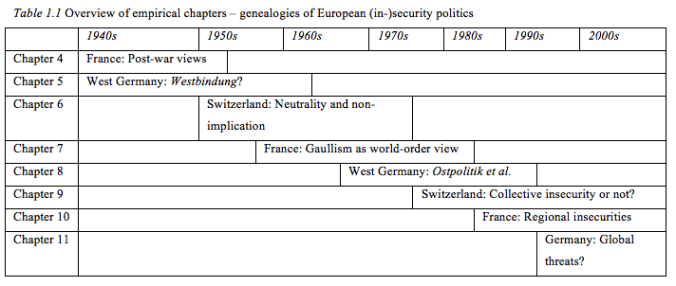
What happens to foreign politics when actors, things or processes are presented as threats? This book explains state’s international behavior based on a reflexive framework of insecurity politics. It argues that governments act on knowledge of international danger available in their societies, and that such knowledge is organized by varying ideas of who threatens whom and how. The book develops this argument and illustrates it by means of various European case studies (Germany, France, and Switzerland in particular). Moving across European history and space, these show how securitization projected abroad evolving – and often contested – local ideas of the organization of international insecurity, and how such knowledges of world politics conditioned foreign policymaking on their own terms. By moving the discipline from systemic theorizing to a theory of international systematization, the book seeks to show how world politics is, in practice, often conceived in a different way than that assumed by grand IR theory. Depicting national insecurity as a matter of political construction, the book also raises the challenging question of whether certain projections of insecurity may be considered more warranted than others.

* Paperback versions of the book can now be ordered through Routledge.

Chapters

Hagmann, Jonas (2015). (In-)security and the production of international relations: The politics of securitisation in Europe. London/New York: Routledge, 244p. URL

Le Temps: Ce que signifie concrètement la politique de sécurité Suisse 

La politique Suisse de sécurité ne se résume pas à ceux qui en écrivent ses rapports. Une analyse du travail au quotidien de ses acteurs, au contact avec les défis sécuritaires de notre temps, permet de brosser le tableau d’un univers de plus en plus interconnecté et en pleine expansion. Un projet de recherche financé par le Fonds national pour la recherche scientifique (FNS) montre qu’en effet, les questions migratoires et de terrorisme constituent aujourd’hui le centre de gravité de la sécurité Suisse, et que ceci fait basculer le champ professionnel et institutionnel vers la gestion de menaces transnationales.

Davidshofer, Stephan; Tawfik, Amal; Wenger, Andreas; Hagmann, Jonas; Wildi, Lisa (2016). Ce que signifie concrètement la politique de sécurité Suisse. Le Temps, 20 December: 10. PDF

Buchkapitel zur praktischen Strukturierung und Vernetzung des Schweizer Sicherheitsfelds

Wer arbeitet heute mit wem und wie intensiv zu welchen Gefahren? Basierend auf einer umfassenden und einzigartigen Datenerhebung kartiert dieser Beitrag die Entwicklung des gesamtschweizerischen Sicherheitsbereichs. Die Darstellung der praktischen Arbeitsteilungen, der inneren und der äusseren Kooperationen, sowie der beruflichen Profile und Werdegänge von Sicherheitspraktikern schafft einen analytisch differenzierten und empirisch fundierten Beitrag zu den anhaltenden Diskussionen über die landesweite sicherheitspolitische Steuerung. So zeigt das Kapitel, wie Sorgen um Migration und Terrorismus nunmehr das Sicherheitsfeld integrieren und das nationale Sicherheitsfeld hierarchisch in anleitende und Service-orientierte Behörden strukturiert, aber auch wie sich die internationale Sicherheitszusammenarbeit zu einer regierungsstufenübergreifenden Praxis wandelte und sich die beruflichen Werdegänge der einzelnen Unterbereiche nun langsam vermischen.


Hagmann, Jonas; Wenger, Andreas; Wildi, Lisa; Davidshofer, Stephan; Tawfik, Amal (2016). Schweizer Sicherheitspolitik in der Praxis: Eine empirische Momentaufnahme. In Nünlist, Christian; Thränert, Oliver (eds.). Bulletin zur Schweizer Sicherheitspolitik, pp99-134. Zürich: Center for Security Studies, ETH Zürich. PDF

Wie wird man Polizist? Buchkapitel zur Polizeiausbildung in der Schweiz

Wie wird man Polizist? Die Aus- und Weiterbildung der Polizei hat sich in den letzten fünfzehn Jahren stark gewandelt. Bildungsstätten wurden fusioniert oder neu geschaffen. Ein nationaler Rahmenlehrplan wurde erstellt und der Berufsabschluss «Polizistin/Polizist» erstmals eidgenössisch anerkannt. Gleichzeitig wurden die Lehrinhalte auf das Erlangen umfassender, spezialisierter Handlungskompetenzen für einen zunehmend komplexen und vernetzten Arbeitsbereich ausgerichtet. Dieses Kapitel zeichnet die Geschichte und die jüngsten Entwicklungen der Schweizer Polizeiausbildung nach. Es zeigt auf, dass trotz Harmonisierung und Professionalisierung regionale Unterschiede und bildungspolitische Herausforderungen fortbestehen.


Wildi, Lisa; Hagmann, Jonas (2016). Vom Landjäger zum modernen Ordnungshüter: Die Polizeiausbildung in der Schweiz. In Nünlist, Christian; Thränert, Oliver (eds.). Bulletin zur Schweizer Sicherheitspolitik, pp71-97. Zürich: Center for Security Studies, ETH Zürich. PDF

NZZ Artikel über die Bedrohungsarbeit, nationale und internationale Vernetzung der Sicherheitsbehörden

Ein Forschungsprojekt liefert erstmals umfassende Einblicke in die Schweizer Sicherheitspolitik, wie sie tagtäglich von Praktikern umgesetzt wird. Wer arbeitet heute mit wem wie intensiv zusammen – und zu welchen Gefahren? Die empirische Momentaufnahme zeigt auf, wie sich das sicherheitspolitische Gesamtsystem vom klassischen Fall der militärischen Landesverteidigung entfernte und heute stark auf Gefahren der globalen Mobilität – Migration und Terrorismus insbesondere – fokussiert. Diese Neuausrichtung wird von neuen landesweiten und grenzübergreifenden Kooperationspraktiken begleitet. Dabei zeigt sich im Bereich der inneren Sicherheit eine besonders ausgeprägte Internationalisierung der Sicherheitsarbeit sowohl von Bund als auch Kantonen. Gleichzeitig wandeln sich die Berufsprofile und Karrierewege der im Politikfeld tätigen Praktiker. Internationale Erfahrungen, akademische Ausbildung, militärische Grade und weitere Kompetenzen werden von verschiedenen Teilbereichen des Arbeitsbereichs neu bewertet.

Hagmann, Jonas; Wenger, Andreas; Wildi, Lisa; Davidshofer, Stephan; Tawfik, Amal (2016). Sicherheit als Verbundaufgabe: Veränderte Bedrohungsszenarien stellen den Bund und die Kantone vor grosse Herausforderungen. Neue Zürcher Zeitung 248, 24 October: 12. PDF

C&C piece on the measurement of national security fields (out now)

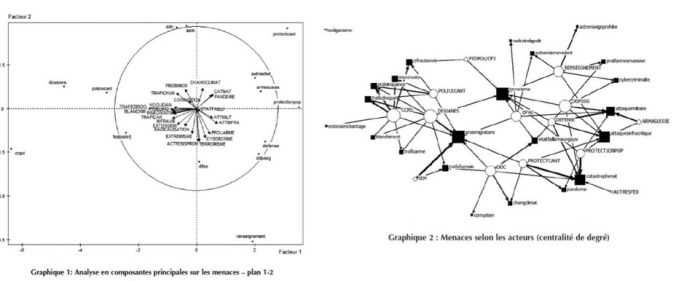
The emergence of a transnational field of security in Europe constitutes a stimulating new observation to security studies research. However, the operationalization of such research is challenging. Notably, time-consuming data collection and data analysis is required to fully comprehend the complex characteristics and resources of a security field’s manifold actors. Drawing on a research project funded by the Swiss National Science Foundation (SNSF), this article offers a substantive analysis of the contemporary dynamics of the Swiss national security field, and it presents some practical ‘tools’ for researchers interested in producing empirical studies of transnational fields of security in Europe. To do so, the article mobilises multiple correspondence analysis, principal component analysis, network analysis and other statistical or statistics-based methods to assess the europeanisation of the Swiss security field.

CC_methods

Davidshofer, Stephan; Tawfik, Amal; Hagmann, Jonas (2016). Analyse du champ de la sécurité en Suisse : vers une hypertrophie de la sécurité intérieure et autres réflexions méthodologiques. Cultures & Conflits 102 (2016/2): 59-93. PDF

JIRD article on securitization as world-ordering practice (out now)

Securitization theory conceptualizes the construction of threats. In its original variant, however, the theory focuses strongly on the deontic (norm-breaking) powers of ‘security talk’ – and not on the threat sceneries that the latter substantively describes. This recent article in the Journal of International Relations and Development addresses this link, reworking securitization into a positional/relational argument. Seen its way, the framing of something as threatening comes with larger – often implicit – claims about threatening and threatened actors in world politics. The empirical cases on post-war France and West Germany show how securitization equals an epistemological systematization of international affairs, thus becoming an ordering process that conditions foreign policy strategizing.

Orders

Hagmann, Jonas (2016). Securitisation and the production of international order(s). Journal of International Relations and DevelopmentPDF

ISR forum on sites of IR knowledge (re-)production (out now)

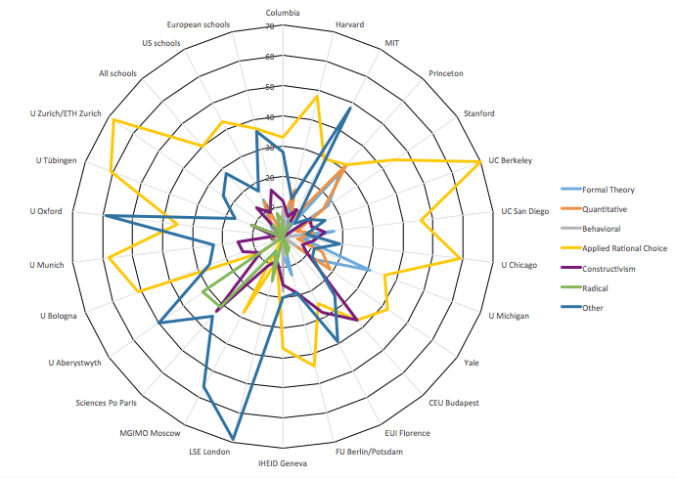
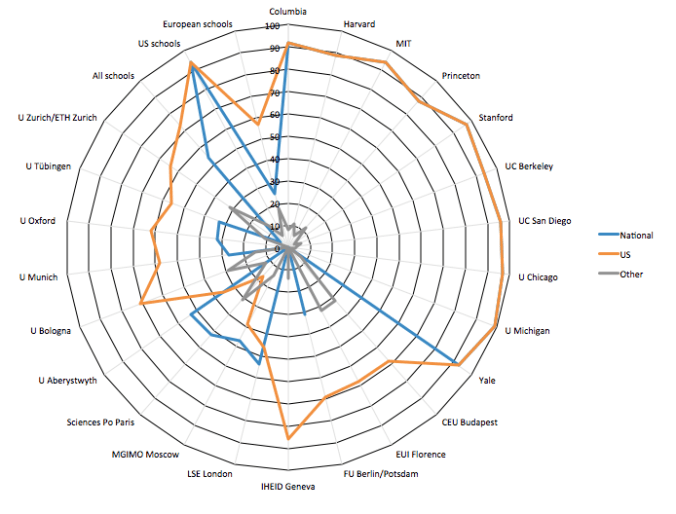
How does the organization of social scientific fields, education policies, and related institutional transformations condition the production and diffusion of scholarly knowledge about world politics? In the latest International Studies Review forum, Félix Grenier and I promote a more dedicated engagement with the disciplines’ institutional sociology. The ambition of the forum, which brings together contributions from Inanna Hamati-Ataya, Tom Biersteker, Thierry Balzacq, Marina Lebedeva, Jason Lane and Martin Müller, is to highlight the diversity of sites and settings where specialized knowledge about international relations is produced, shaped and re-instantiated.

Hagmann, Jonas; Lebedeva, Marina (2016). Teaching (as) statist practice: Diplomatic schools as sites of international education. International Studies Review 18(2): 349-353. PDF

Grenier, Félix; Hagmann, Jonas (2016). Sites of knowledge (re-)production: Towards an institutional sociology of International Relations scholarship. International Studies Review 18(2): 333-336. PDF

BISA @40 Blogpost: Does everyone need a national IR school?

At the ISA Annual Convention in New Orleans numerous scholars drew on the sociology of IR literature to call for the creation of ‘national IR schools’, i.e., new and exclusively locally defined approaches to world politics and international analysis. An Indian school of IR ranked prominently among the candidates, but so did a Chinese school of IR, an Anatolian and a Brazilian one, and further propositions made at the panels and roundtables I attended centred on Eastern Europe. Hearing these calls, I wondered: Is the institutionalization of national IR disciplines really what the sociology of IR research agenda seeks to achieve?

Hagmann, Jonas (2016). Does everyone need a national IR school? Engaging the sociology of IR’s most recent appropriation. British International Studies Association BISA @40 Posts. 12 February. PDF

ISR forum on the ‘institutional sociology’ of International Relations

How does the organization of social scientific fields, education policies, and related institutional transformations condition the production and diffusion of scholarly knowledge about world politics? In an upcoming International Studies Review forum, Félix Grenier and I seek to promote a more dedicated engagement with the disciplines’ institutional sociology. The ambition of the forum, which brings together contributions from Inanna Hamati-Ataya, Tom Biersteker, Thierry Balzacq, Marina Lebedeva, Jason Lane and Martin Müller, is to highlight the diversity of sites and settings where specialized knowledge about international relations is produced, shaped and re-instantiated.

Hagmann, Jonas; Lebedeva, Marina (forthcoming). Teaching (as) statist practice: Diplomatic schools as sites of international education. International Studies ReviewPDF

Grenier, Félix; Hagmann, Jonas (forthcoming). Sites of knowledge (re-)production: Towards an institutional sociology of International Relations scholarship. International Studies ReviewPDF