 It is generally accepted today that major international events – such as in 1914, 1945, 1989 or 2001 – contribute to guiding IR scholarship’s interests. But it remains poorly explored how, beyond substantive focus, transformative political events affect the academic field’s own working and organization. Whereas we know that global key moments (such as the end of the Cold War) were or are experienced differently by different societies, at the policy level, in terms of identity-construction and historiography, it remains to explore how such changes influence scholarly work in different higher education systems. Our article in International Studies Perspectives focuses on this link. It centers on the role of institutional factors in the conditioning of IR scholarship, which it sees as important yet under-explored intervening elements in the interrelation between political events and academic practice. The article defines the utility of such focus and illustrates it with casework centering on the end of the Cold War, and three central parties to the Cold War conflict – Russia as representative of the Eastern Bloc, Canada of the Western Alliance, and Switzerland as a Neutral polity. In doing so, the article showcases how institutional factors such as funding schemes, the marketization of education or creation of new IR departments operate as effective ‘hinges’, exerting significant influence over the ways scholars develop ideas about international relations.
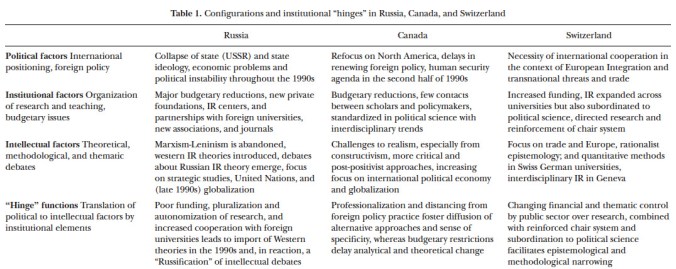
Grenier, Félix; Hagmann, Jonas; Lebedeva, Marina; Nikitina, Yulia; Biersteker, Thomas; Koldunova, Ekatarina (2020). The institutional ‘hinge’: How the end of the Cold War conditioned Canadian, Russian and Swiss IR scholarship. International Studies Perspectives 21(2): 198-217. PDF
 Contemporary security practices rarely represent new inventions – albeit change is important to it, the security politics of today often has a very long lineage. It adapts, reworks and sometimes just rehashes old ideas and practices of policing, and is embedded in deeply entrenched, historically grown and power-laden frameworks of collective, national, local or international sense- and decision-making. This contribution to Contemporanea‘s Special Section on the “History of Transnational Security Management in Europe” argues that is
  What does it take to safeguard a country like Switzerland? And is the national security system, which exudes certainty to those controlled by its agents, indeed as fortified as it appears? This essay chapter in Salvatore Vitale’s photographic visual study of 21st century statehood discusses the history and political sociology of the Swiss national security field. It lends a special eye to the the authorities capable of defining what security is or ought to be about, and asks whether the field has become more accessible and participatory in recent years.
 ‘Security’ has for the most part been considered a special kind of politics by observers, as one that closes down inclusive policy-making and democratic debate. This Special Issue reviews theoretical and empirical developments at the intersections of ‘security’ and ‘politics’. It argues that research centering on the notion of politicization offers new ideas on how to addresses this complex and evolving conceptual tandem, and importantly, helps elucidate the growing range of actors, arenas and arguments factually visible in contemporary security affairs. The Special Issue develops a framework around the dimensions of controversy, mobilization and arena-shifting, and showcases the potential of such a perspective through empirical illustrations and theoretical examinations, covering issues such as post-Snowden public-policy controversy in Germany, lay participation in European security strategy-making, and the evolving role of the British parliament in UK security politics. The Special Issue’s ambition is to re-engage the relationship between security and politics, to inspire innovative new empirical work on ‘politics around security’, and to empower more differentiated inquiries into the ambivalent consequences of politicization.
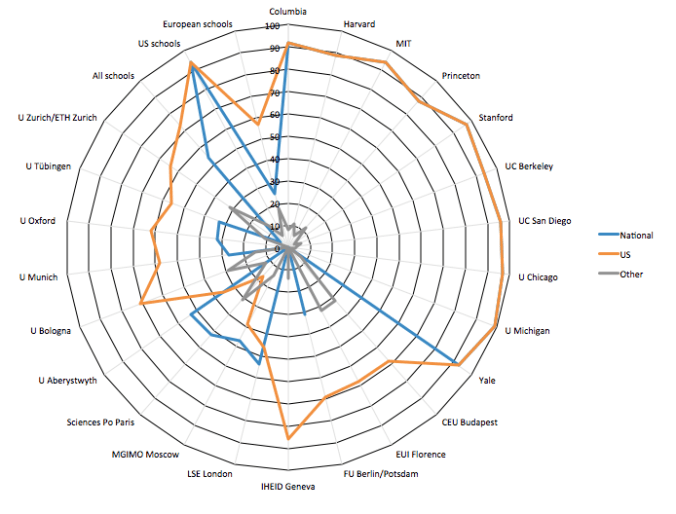
 Publication metrics are preferred measures of the academic discipline called International Relations (IR). Yet, article writing is not all what scholars do, and indicators focusing on other scholarly activities – such as most notably, teaching – draw other pictures of intellectual hierarchy in the field. In the newly minted SAGE Handbook of the History, Philosophy and Sociology of International Relations, Tom Biersteker and I propose to also approach IR as a pedagogical field. Drawing on an extended empirical data-collection effort, we look at and dis-aggregate the core IR courses of 23 Western universities in terms of paradigmatic penchants and intellectual origins. In doing so, our ambition is to problematise popular and powerful cartographies of international scholarship, and to define academic work in more comprehensive – and dare one say, balanced – ways.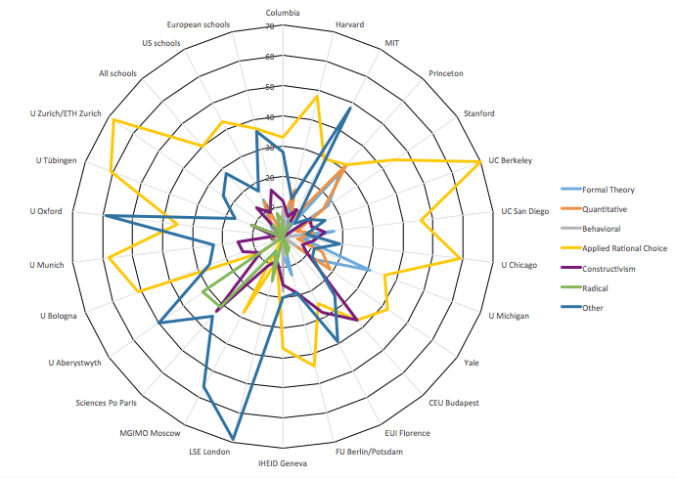
 It is widely known that national security fields changed considerably in the last decades. Different from the late Cold War years, when they focused on military threats, were closely orchestrated by Defence Ministries and contained few international contacts, national security ‘systems’ today handle wide sets of dangers, draw on complex casts of actors across levels of government, and often maintain working relations with multiple foreign partners. This comprehensive reconfiguration of national security fields is a central theme to security scholars and policymakers alike – but also difficult to pin down for methodological reasons. Written documentation on security agencies does not give precise indication of actual everyday inter-agency work practices, and assessments of nationwide security work across functions and levels of government are challenging by sheer questions of size. Adopting a practice-oriented approach to security research, this article draws on an unparalleled nationwide data collection effort to differentiate and map-out the Swiss security field’s programmatic and institutional evolution.

 How do notions of collective international insecurity come about, and what are their effects on foreign policy-making? The Copenhagen School’s securitization theory offers a powerful take on the political construction of threats. In its original variant, however, the theory focuses strongly on the deontic (norm-breaking) powers of ‘security talk’ – and not on the threat sceneries that the latter substantively describes. This article addresses this latter link by reworking securitization into a positional/relational argument. Seen its way, the framing of something as threatening comes with larger – often implicit – claims about threatening and threatened actors in world politics. The empirical cases on post-war France and West Germany show how securitization equals an epistemological systematization of international affairs, for the political construction of collective international danger becomes an ordering process that conditions foreign policy strategizing.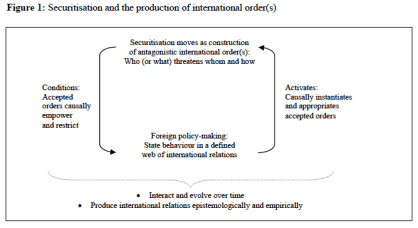
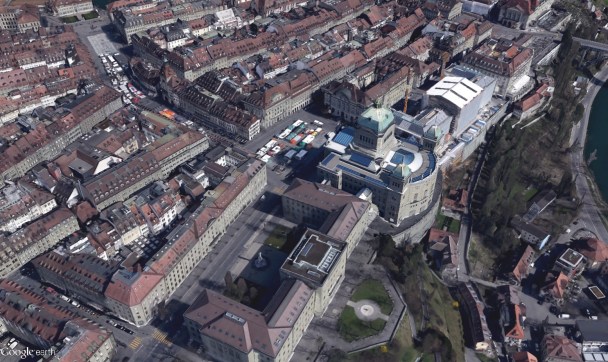
 Depuis la naissance de la Suisse moderne en 1848, sécurité a constamment rimé avec neutralité. De nos jours, cette dernière reste encore perçue par une large majorité de Suisses comme une garantie de protection face aux tumultes du monde. Cependant, dans la pratique, cette singularité est remise en question. Notre article dans Questions internationales démontre que dans un monde interdépendant, l’impératif de coopération, indispensable pour gérer les menaces avant tout globales et transnationales, s’accompagne d’une discrète mais profonde transformation du paysage sécuritaire du pays situé au cœur de l’Europe.
