IPS article on the politics and practices of securing urban spaces

There is much agreement that urban security dispositives acquired new qualities in recent years. But do the dominant diagnoses hold up to detailed empirical verification? This forthcoming piece in International Political Sociology re-engages the pertinent security studies literature. In the age of globalisation and urbanisation, technological innovation and liberal policy ideals, how are urban security apparatuses reorganised, and in what relations do they stand to local societal and political orders? Describing the evolving security handling of three urban spaces – a site of mobility (HB Zürich), a public square (Bundesplatz Bern) and a place of mass commerce (St. Jakob Park Basel) –, the article makes the case for more nuanced engagements with urban security ensembles, their technological evolution, relations with democratic ideals, globalisation and de-territorialisation both in and beyond Western polities.

Securing public space in Switzerland – Bundesplatz Bern     Bundesplatz.jpg

Hagmann, Jonas (forthcoming). Security in the society of control: The politics and practices of securing urban spaces. International Political Sociology. PDF
Counter-mapping the discipline: Book chapter on Western IR teaching

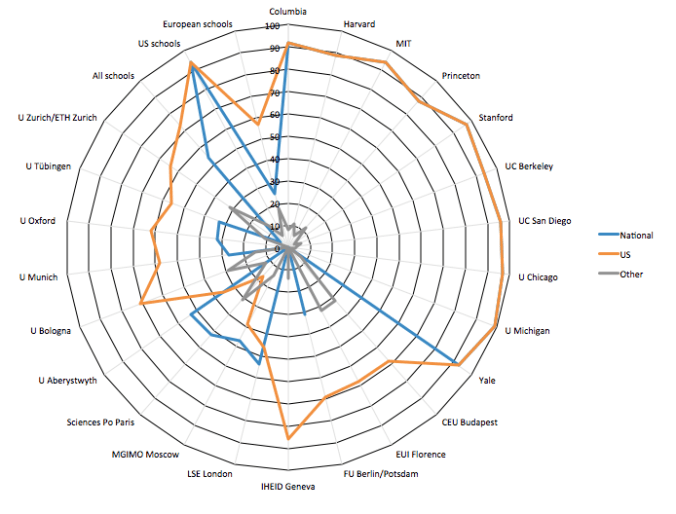
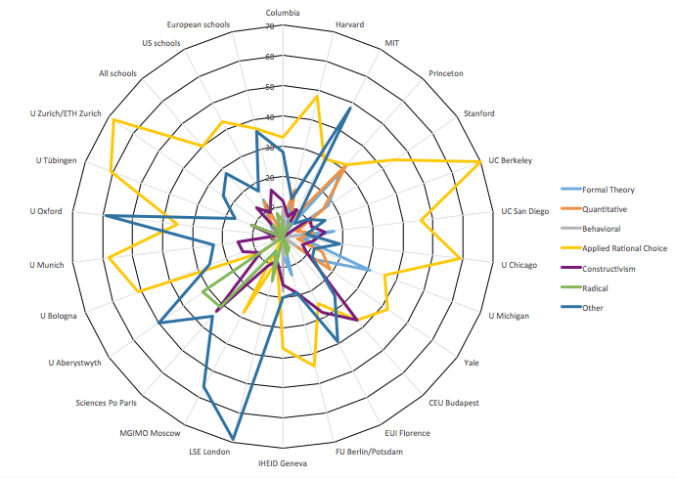
Who teaches whose and what kind of knowledge at leading US and European IR schools? In a chapter in the upcoming SAGE Handbook of the History, Philosophy and Sociology of International Relations, Tom Biersteker and I analyse the core IR courses of 23 universities. The chapter unpacks these courses’ paradigmatic penchants and the authorship on which they draw. By looking at the ‘instructed’ and not the ‘published discipline’, it seeks to draw another picture of International Relations scholarship. In doing so, the aim is to problematise the powerful ontologies of scholarly work that underpin existing mappings of the discipline.

Paradigmatic penchants in core IR coursesIR_schools_paradigmatic

Sources of international knowledge IR_schools_authororigin

Hagmann, Jonas; Biersteker, Thomas (forth). Counter-mapping the discipline: The archipelago of Western International Relations teaching. In: Gofas, Andreas; Hamati-Ataya, Inanna; Onuf, Nick (eds.). The SAGE Handbook of the History, Philosophy and Sociology of International Relations. London/New York: SAGE. PDF / Illustrations

Research stay at Kathmandu School of Law in fall 2017

From 1 September 2017 – 30 November 2017, I will be a Visiting Faculty at the Kathmandu School of Law’s Research Department . The research stay serves to connect to local urban and security studies specialists, and to conduct field research on the reconfiguration of urban security management in different sub-city laboratories, the Gongabu New Bus Park, the Basantapur Durbar Square, Thamel, and the Lajimpat residential area.

KLS

Book “(In)Security and the Production of International Relations” now in paperback

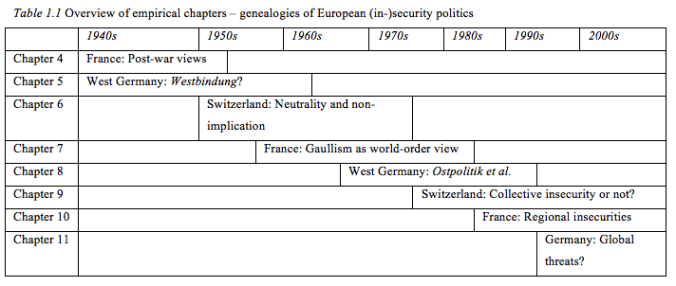
What happens to foreign politics when actors, things or processes are presented as threats? This book explains state’s international behavior based on a reflexive framework of insecurity politics. It argues that governments act on knowledge of international danger available in their societies, and that such knowledge is organized by varying ideas of who threatens whom and how. The book develops this argument and illustrates it by means of various European case studies (Germany, France, and Switzerland in particular). Moving across European history and space, these show how securitization projected abroad evolving – and often contested – local ideas of the organization of international insecurity, and how such knowledges of world politics conditioned foreign policymaking on their own terms. By moving the discipline from systemic theorizing to a theory of international systematization, the book seeks to show how world politics is, in practice, often conceived in a different way than that assumed by grand IR theory. Depicting national insecurity as a matter of political construction, the book also raises the challenging question of whether certain projections of insecurity may be considered more warranted than others.

* Paperback versions of the book can now be ordered through Routledge.

Chapters

Hagmann, Jonas (2015). (In-)security and the production of international relations: The politics of securitisation in Europe. London/New York: Routledge, 244p. URL

Pro Helvetia/Swiss Arts Council mandate: Bilderberg 2017

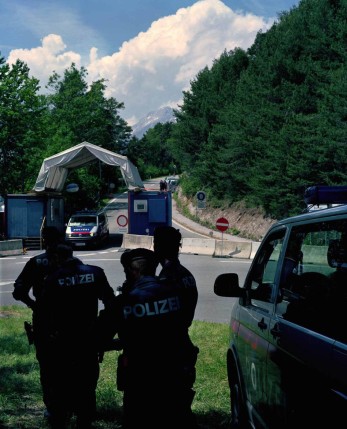
During the year 2017, I am counselling another Pro Helvetia Förderprojekt in visual arts. The project is developed by photographer Giacomo Bianchetti. It addresses the power of global corporations, the collusion of public and private stakeholders, as well as the exclusionary dispositives by which annual Bilderberg meetings are accompanied. Having followed the latter conferences for many years and through different European countries, Giacomo’s Bilderberg 2017 project develops a new technological and visual rendering of this high-level get-together, while also contrasting it with his previous works and exhibitions.

For more information visit Giacomo Bianchetti’s website or download his publication on Bilderberg 2015 in Telfs-Buchen (Austria) here.

bilderberg2015

Le Temps: Ce que signifie concrètement la politique de sécurité Suisse 

La politique Suisse de sécurité ne se résume pas à ceux qui en écrivent ses rapports. Une analyse du travail au quotidien de ses acteurs, au contact avec les défis sécuritaires de notre temps, permet de brosser le tableau d’un univers de plus en plus interconnecté et en pleine expansion. Un projet de recherche financé par le Fonds national pour la recherche scientifique (FNS) montre qu’en effet, les questions migratoires et de terrorisme constituent aujourd’hui le centre de gravité de la sécurité Suisse, et que ceci fait basculer le champ professionnel et institutionnel vers la gestion de menaces transnationales.

Davidshofer, Stephan; Tawfik, Amal; Wenger, Andreas; Hagmann, Jonas; Wildi, Lisa (2016). Ce que signifie concrètement la politique de sécurité Suisse. Le Temps, 20 December: 10. PDF

Buchkapitel zur praktischen Strukturierung und Vernetzung des Schweizer Sicherheitsfelds

Wer arbeitet heute mit wem und wie intensiv zu welchen Gefahren? Basierend auf einer umfassenden und einzigartigen Datenerhebung kartiert dieser Beitrag die Entwicklung des gesamtschweizerischen Sicherheitsbereichs. Die Darstellung der praktischen Arbeitsteilungen, der inneren und der äusseren Kooperationen, sowie der beruflichen Profile und Werdegänge von Sicherheitspraktikern schafft einen analytisch differenzierten und empirisch fundierten Beitrag zu den anhaltenden Diskussionen über die landesweite sicherheitspolitische Steuerung. So zeigt das Kapitel, wie Sorgen um Migration und Terrorismus nunmehr das Sicherheitsfeld integrieren und das nationale Sicherheitsfeld hierarchisch in anleitende und Service-orientierte Behörden strukturiert, aber auch wie sich die internationale Sicherheitszusammenarbeit zu einer regierungsstufenübergreifenden Praxis wandelte und sich die beruflichen Werdegänge der einzelnen Unterbereiche nun langsam vermischen.


Hagmann, Jonas; Wenger, Andreas; Wildi, Lisa; Davidshofer, Stephan; Tawfik, Amal (2016). Schweizer Sicherheitspolitik in der Praxis: Eine empirische Momentaufnahme. In Nünlist, Christian; Thränert, Oliver (eds.). Bulletin zur Schweizer Sicherheitspolitik, pp99-134. Zürich: Center for Security Studies, ETH Zürich. PDF

Wie wird man Polizist? Buchkapitel zur Polizeiausbildung in der Schweiz

Wie wird man Polizist? Die Aus- und Weiterbildung der Polizei hat sich in den letzten fünfzehn Jahren stark gewandelt. Bildungsstätten wurden fusioniert oder neu geschaffen. Ein nationaler Rahmenlehrplan wurde erstellt und der Berufsabschluss «Polizistin/Polizist» erstmals eidgenössisch anerkannt. Gleichzeitig wurden die Lehrinhalte auf das Erlangen umfassender, spezialisierter Handlungskompetenzen für einen zunehmend komplexen und vernetzten Arbeitsbereich ausgerichtet. Dieses Kapitel zeichnet die Geschichte und die jüngsten Entwicklungen der Schweizer Polizeiausbildung nach. Es zeigt auf, dass trotz Harmonisierung und Professionalisierung regionale Unterschiede und bildungspolitische Herausforderungen fortbestehen.


Wildi, Lisa; Hagmann, Jonas (2016). Vom Landjäger zum modernen Ordnungshüter: Die Polizeiausbildung in der Schweiz. In Nünlist, Christian; Thränert, Oliver (eds.). Bulletin zur Schweizer Sicherheitspolitik, pp71-97. Zürich: Center for Security Studies, ETH Zürich. PDF

NZZ Artikel über die Bedrohungsarbeit, nationale und internationale Vernetzung der Sicherheitsbehörden

Ein Forschungsprojekt liefert erstmals umfassende Einblicke in die Schweizer Sicherheitspolitik, wie sie tagtäglich von Praktikern umgesetzt wird. Wer arbeitet heute mit wem wie intensiv zusammen – und zu welchen Gefahren? Die empirische Momentaufnahme zeigt auf, wie sich das sicherheitspolitische Gesamtsystem vom klassischen Fall der militärischen Landesverteidigung entfernte und heute stark auf Gefahren der globalen Mobilität – Migration und Terrorismus insbesondere – fokussiert. Diese Neuausrichtung wird von neuen landesweiten und grenzübergreifenden Kooperationspraktiken begleitet. Dabei zeigt sich im Bereich der inneren Sicherheit eine besonders ausgeprägte Internationalisierung der Sicherheitsarbeit sowohl von Bund als auch Kantonen. Gleichzeitig wandeln sich die Berufsprofile und Karrierewege der im Politikfeld tätigen Praktiker. Internationale Erfahrungen, akademische Ausbildung, militärische Grade und weitere Kompetenzen werden von verschiedenen Teilbereichen des Arbeitsbereichs neu bewertet.

Hagmann, Jonas; Wenger, Andreas; Wildi, Lisa; Davidshofer, Stephan; Tawfik, Amal (2016). Sicherheit als Verbundaufgabe: Veränderte Bedrohungsszenarien stellen den Bund und die Kantone vor grosse Herausforderungen. Neue Zürcher Zeitung 248, 24 October: 12. PDF

C&C piece on the measurement of national security fields (out now)

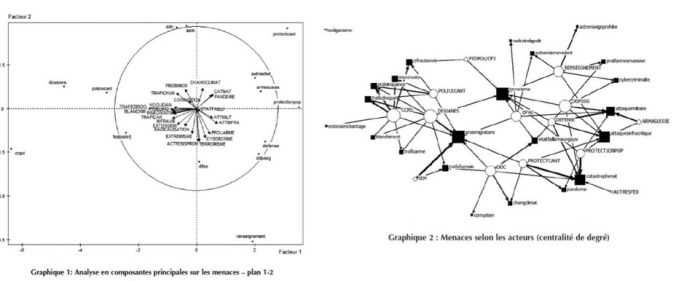
The emergence of a transnational field of security in Europe constitutes a stimulating new observation to security studies research. However, the operationalization of such research is challenging. Notably, time-consuming data collection and data analysis is required to fully comprehend the complex characteristics and resources of a security field’s manifold actors. Drawing on a research project funded by the Swiss National Science Foundation (SNSF), this article offers a substantive analysis of the contemporary dynamics of the Swiss national security field, and it presents some practical ‘tools’ for researchers interested in producing empirical studies of transnational fields of security in Europe. To do so, the article mobilises multiple correspondence analysis, principal component analysis, network analysis and other statistical or statistics-based methods to assess the europeanisation of the Swiss security field.

CC_methods

Davidshofer, Stephan; Tawfik, Amal; Hagmann, Jonas (2016). Analyse du champ de la sécurité en Suisse : vers une hypertrophie de la sécurité intérieure et autres réflexions méthodologiques. Cultures & Conflits 102 (2016/2): 59-93. PDF