What are technologies of violence, and how did they evolve? How do technologies relate to power relations in the field, and how do they instruct empirical and analytical work in the International Relations discipline? This conversation with Keith Krause, Professor at the Graduate Institute of International and Development Studies (IHEID) in Geneva and Director the Centre on Conflict, Development and Peacebuilding (CCDP) there, explores how technologies of violence evolved over time, and with what effects on security practice and analysis.
Keith Krause

Dunn Cavelty, Myriam; Hagmann, Jonas (2018). Technologies of violence: A conversation with Keith Krause. In Kaltofen, Carolin; Carr, Madeline; Acuto, Michele (eds.). Technologies of International Relations: Continuity and Change, pp97-106. London/New York: Palgrave MacMillan. PDF
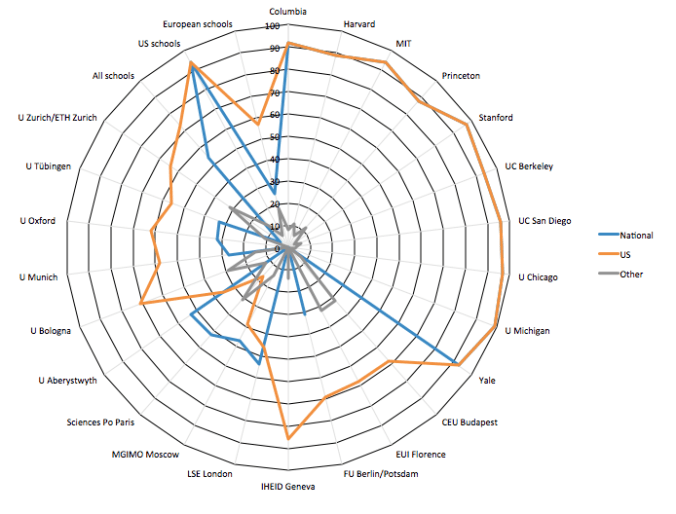
 Publication metrics are preferred measures of the academic discipline called International Relations (IR). Yet, article writing is not all what scholars do, and indicators focusing on other scholarly activities – such as most notably, teaching – draw other pictures of intellectual hierarchy in the field. In the newly minted SAGE Handbook of the History, Philosophy and Sociology of International Relations, Tom Biersteker and I propose to also approach IR as a pedagogical field. Drawing on an extended empirical data-collection effort, we look at and dis-aggregate the core IR courses of 23 Western universities in terms of paradigmatic penchants and intellectual origins. In doing so, our ambition is to problematise popular and powerful cartographies of international scholarship, and to define academic work in more comprehensive – and dare one say, balanced – ways.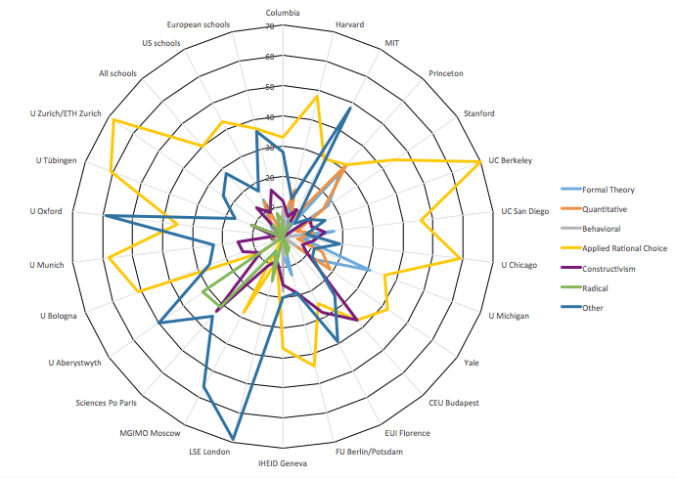
 It is widely known that national security fields changed considerably in the last decades. Different from the late Cold War years, when they focused on military threats, were closely orchestrated by Defence Ministries and contained few international contacts, national security ‘systems’ today handle wide sets of dangers, draw on complex casts of actors across levels of government, and often maintain working relations with multiple foreign partners. This comprehensive reconfiguration of national security fields is a central theme to security scholars and policymakers alike – but also difficult to pin down for methodological reasons. Written documentation on security agencies does not give precise indication of actual everyday inter-agency work practices, and assessments of nationwide security work across functions and levels of government are challenging by sheer questions of size. Adopting a practice-oriented approach to security research, this article draws on an unparalleled nationwide data collection effort to differentiate and map-out the Swiss security field’s programmatic and institutional evolution.



 How do notions of collective international insecurity come about, and what are their effects on foreign policy-making? The Copenhagen School’s securitization theory offers a powerful take on the political construction of threats. In its original variant, however, the theory focuses strongly on the deontic (norm-breaking) powers of ‘security talk’ – and not on the threat sceneries that the latter substantively describes. This article addresses this latter link by reworking securitization into a positional/relational argument. Seen its way, the framing of something as threatening comes with larger – often implicit – claims about threatening and threatened actors in world politics. The empirical cases on post-war France and West Germany show how securitization equals an epistemological systematization of international affairs, for the political construction of collective international danger becomes an ordering process that conditions foreign policy strategizing.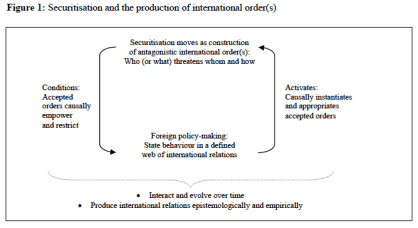
 Depuis la naissance de la Suisse moderne en 1848, sécurité a constamment rimé avec neutralité. De nos jours, cette dernière reste encore perçue par une large majorité de Suisses comme une garantie de protection face aux tumultes du monde. Cependant, dans la pratique, cette singularité est remise en question. Notre article dans Questions internationales démontre que dans un monde interdépendant, l’impératif de coopération, indispensable pour gérer les menaces avant tout globales et transnationales, s’accompagne d’une discrète mais profonde transformation du paysage sécuritaire du pays situé au cœur de l’Europe.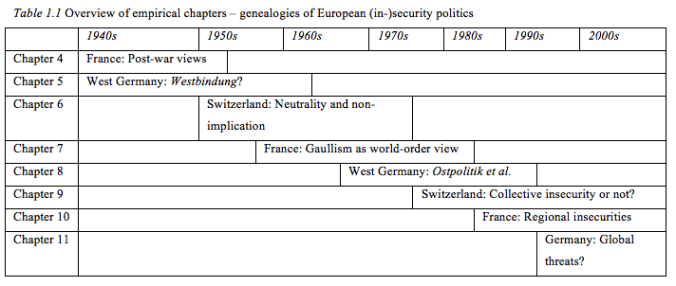

 :: Jonas Hagmann ::