The speed and scale of contemporary urbanization is unprecedented, and it brings along tremendous social, environmental, economic and politics problems – while also generating enormous opportunities for livelihood improvement. With a new Future Cities Lab Global, ETH Zürich seeks to integrate and strategically advance its natural science competencies in the domain of urban science. The ambition of FCL Global, on whose research plans and governance scheme I currently counsel, and which brings together about 25 professorships and senior scientists, and 50 post-docs and PhD students, is to produce inter-disciplinary and transformative research, teaching and public outreach. Focussing on the challenges of digitization, inclusive planning, blue/green/bright infrastructure development and public health-oriented design, among other things, it seeks to promote more sustainable forms of urbanization in European and Asian settlements, through science, by design, and in place.


Grêt-Regamey, Adrienne; Cairns, Stephen; Erath, Alex; Hagmann, Jonas; Stokols, Andrew (2018). Future Cities Lab Global: Outline Proposal. Singapore/Zürich: ETH Zürich and FCL Singapore, 88p. noPDF
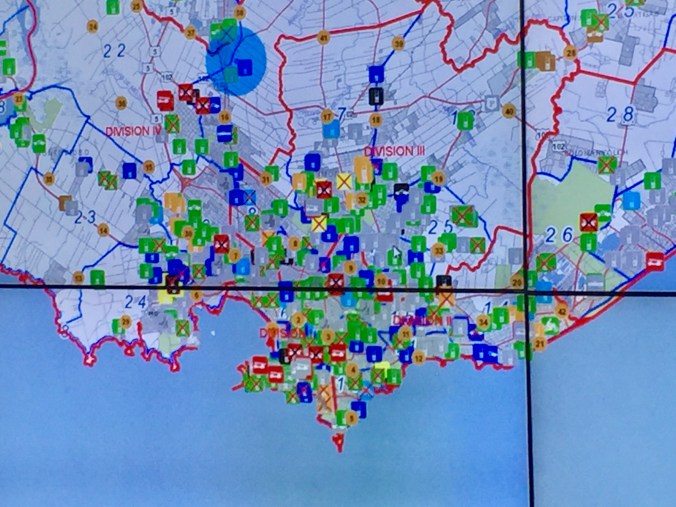



 It is widely known that national security fields changed considerably in the last decades. Different from the late Cold War years, when they focused on military threats, were closely orchestrated by Defence Ministries and contained few international contacts, national security ‘systems’ today handle wide sets of dangers, draw on complex casts of actors across levels of government, and often maintain working relations with multiple foreign partners. This comprehensive reconfiguration of national security fields is a central theme to security scholars and policymakers alike – but also difficult to pin down for methodological reasons. Written documentation on security agencies does not give precise indication of actual everyday inter-agency work practices, and assessments of nationwide security work across functions and levels of government are challenging by sheer questions of size. Adopting a practice-oriented approach to security research, this article draws on an unparalleled nationwide data collection effort to differentiate and map-out the Swiss security field’s programmatic and institutional evolution.


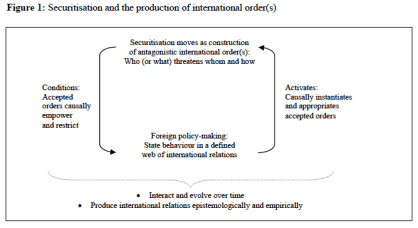
 How do notions of collective international insecurity come about, and what are their effects on foreign policy-making? The Copenhagen School’s securitization theory offers a powerful take on the political construction of threats. In its original variant, however, the theory focuses strongly on the deontic (norm-breaking) powers of ‘security talk’ – and not on the threat sceneries that the latter substantively describes. This article addresses this latter link by reworking securitization into a positional/relational argument. Seen its way, the framing of something as threatening comes with larger – often implicit – claims about threatening and threatened actors in world politics. The empirical cases on post-war France and West Germany show how securitization equals an epistemological systematization of international affairs, for the political construction of collective international danger becomes an ordering process that conditions foreign policy strategizing.