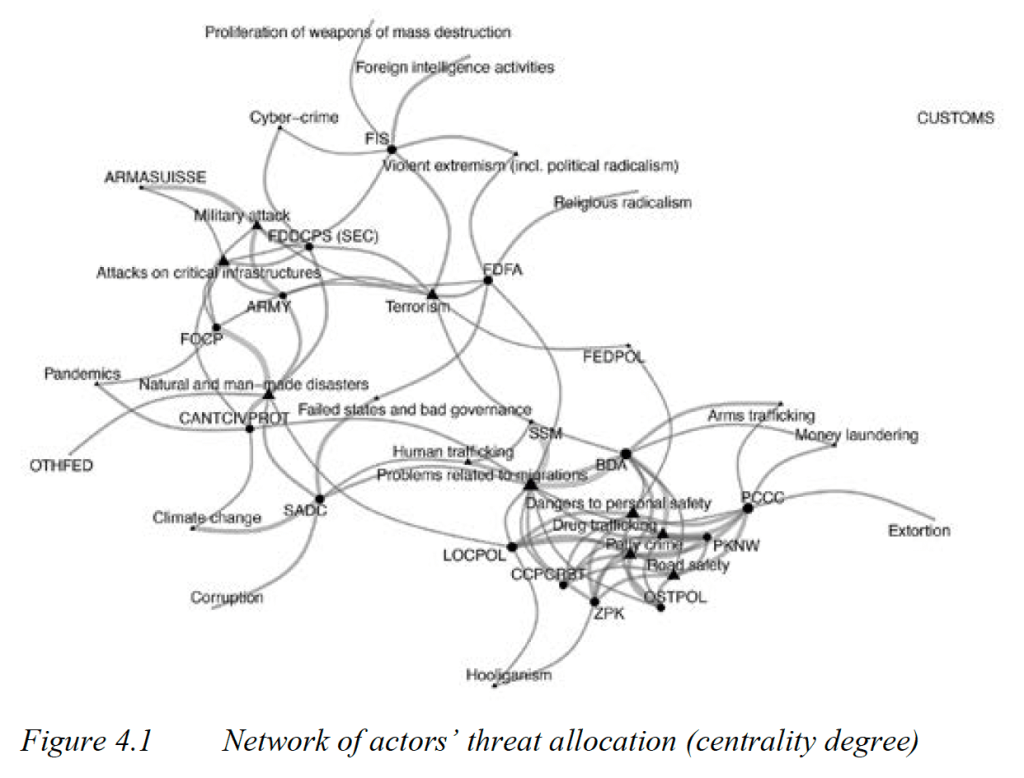
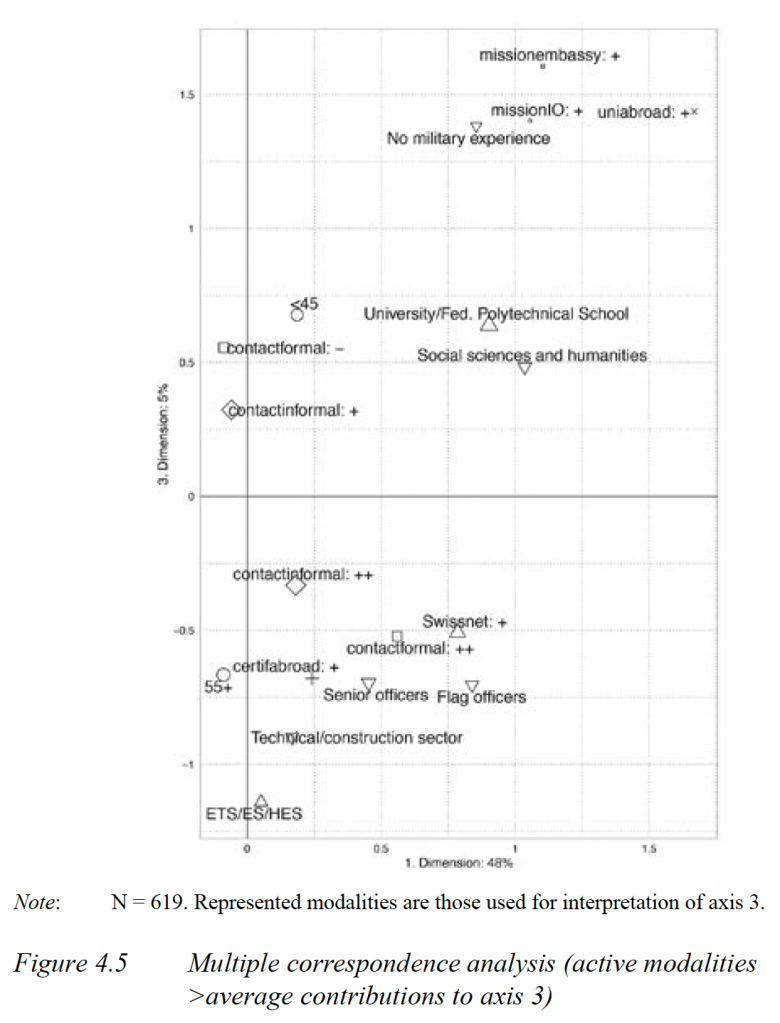
National security policy defies easy analysis. State action in the security domain is extraordinarily diverse and wide-ranging, stretching from defense and diplomacy to civil protection, public order and social security. As a result, conventional differentiations – such as between internal and external security, police and military, or public and private security production – became outdated and do not provide sufficient analytical to understand how the national security is configured and evolving. Bourdieu’s field theory is one useful way to better capture the complexity of the national security domain. In its view, the numerous specialists active in the domain form a larger professional space, whose inner workings are co-determined by positions, knowledges, individual skills and professional practices that may themselves be competing with one another. The chapter sets out this understanding and offers a deep empirical account of the Swiss national security field’s (re-)configuration in the 2010s. It shows what actors worked on what kind of security challenge(s) and in collaboration with whom, and it charts the forms of ‘capital’ (education, professional experiences, military ranks etc.) on which these practices were drawing.
Who work on what threats? The production of national security in Switzerland in the 2010s
On what forms of ‘capital’ are the practices based? Switzerland in the 2010s
Davidshofer, Stephan; Tawfik, Amal; Hagmann, Jonas (2024). Security as a field of force: the case of Switzerland in the mid-2010s. In: Dubois, Vincent (ed.). Bringing Bourdieu’s Theory of Fields to Critical Policy Analysis, pp. 74-89. Cheltenham: Edward Elgar. PDF
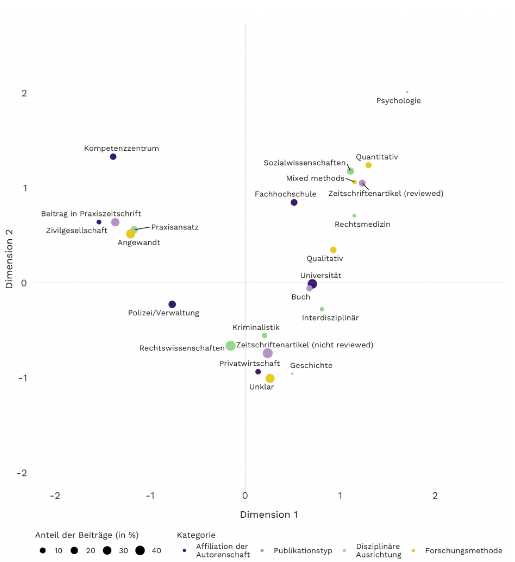


 La sécurité est un objet de recherche protéiforme et mouvant par excellence, pour preuve l’incontournable entrée en matière l’évoquant en général comme un concept essentiellement contesté. Ainsi, aborder la question de l’ action de l’État en matière de sécurité renvoie à des univers sociaux et des pratiques extrêmement diverses. En mobilisant le concept de champ, ce chapitre propose de penser de manière relationnelle la production des savoirs sur l’(in)sécurité comme émanant d’un espace social autonome et dynamique généré par des agents pouvant être définis comme des professionnels de la gestion de la menace et des inquiétudes. Issue d’un projet de recherche financé par le Fonds national suisse de la recherche scientifique, la contribution a le double objectif de mobiliser la littérature existante sur le champ de la sécurité afin d’analyser les dynamiques contemporaines de sécurité en Suisse et de proposer des solutions pratiques pour tout chercheur souhaitant mener une analyse systématique de la sorte.

 It is generally accepted today that major international events – such as in 1914, 1945, 1989 or 2001 – contribute to guiding IR scholarship’s interests. But it remains poorly explored how, beyond substantive focus, transformative political events affect the academic field’s own working and organization. Whereas we know that global key moments (such as the end of the Cold War) were or are experienced differently by different societies, at the policy level, in terms of identity-construction and historiography, it remains to explore how such changes influence scholarly work in different higher education systems. Our article in International Studies Perspectives focuses on this link. It centers on the role of institutional factors in the conditioning of IR scholarship, which it sees as important yet under-explored intervening elements in the interrelation between political events and academic practice. The article defines the utility of such focus and illustrates it with casework centering on the end of the Cold War, and three central parties to the Cold War conflict – Russia as representative of the Eastern Bloc, Canada of the Western Alliance, and Switzerland as a Neutral polity. In doing so, the article showcases how institutional factors such as funding schemes, the marketization of education or creation of new IR departments operate as effective ‘hinges’, exerting significant influence over the ways scholars develop ideas about international relations.
 Contemporary security practices rarely represent new inventions – albeit change is important to it, the security politics of today often has a very long lineage. It adapts, reworks and sometimes just rehashes old ideas and practices of policing, and is embedded in deeply entrenched, historically grown and power-laden frameworks of collective, national, local or international sense- and decision-making. This contribution to Contemporanea‘s Special Section on the “History of Transnational Security Management in Europe” argues that is
  What does it take to safeguard a country like Switzerland? And is the national security system, which exudes certainty to those controlled by its agents, indeed as fortified as it appears? This essay chapter in Salvatore Vitale’s photographic visual study of 21st century statehood discusses the history and political sociology of the Swiss national security field. It lends a special eye to the the authorities capable of defining what security is or ought to be about, and asks whether the field has become more accessible and participatory in recent years.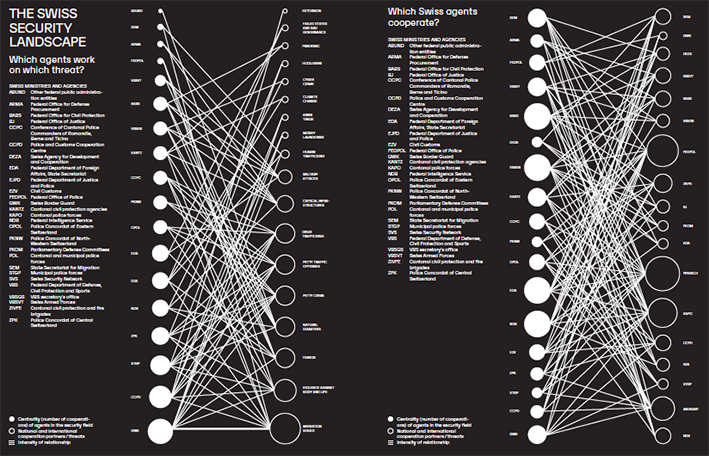
 ‘Security’ has for the most part been considered a special kind of politics by observers, as one that closes down inclusive policy-making and democratic debate. This Special Issue reviews theoretical and empirical developments at the intersections of ‘security’ and ‘politics’. It argues that research centering on the notion of politicization offers new ideas on how to addresses this complex and evolving conceptual tandem, and importantly, helps elucidate the growing range of actors, arenas and arguments factually visible in contemporary security affairs. The Special Issue develops a framework around the dimensions of controversy, mobilization and arena-shifting, and showcases the potential of such a perspective through empirical illustrations and theoretical examinations, covering issues such as post-Snowden public-policy controversy in Germany, lay participation in European security strategy-making, and the evolving role of the British parliament in UK security politics. The Special Issue’s ambition is to re-engage the relationship between security and politics, to inspire innovative new empirical work on ‘politics around security’, and to empower more differentiated inquiries into the ambivalent consequences of politicization.
