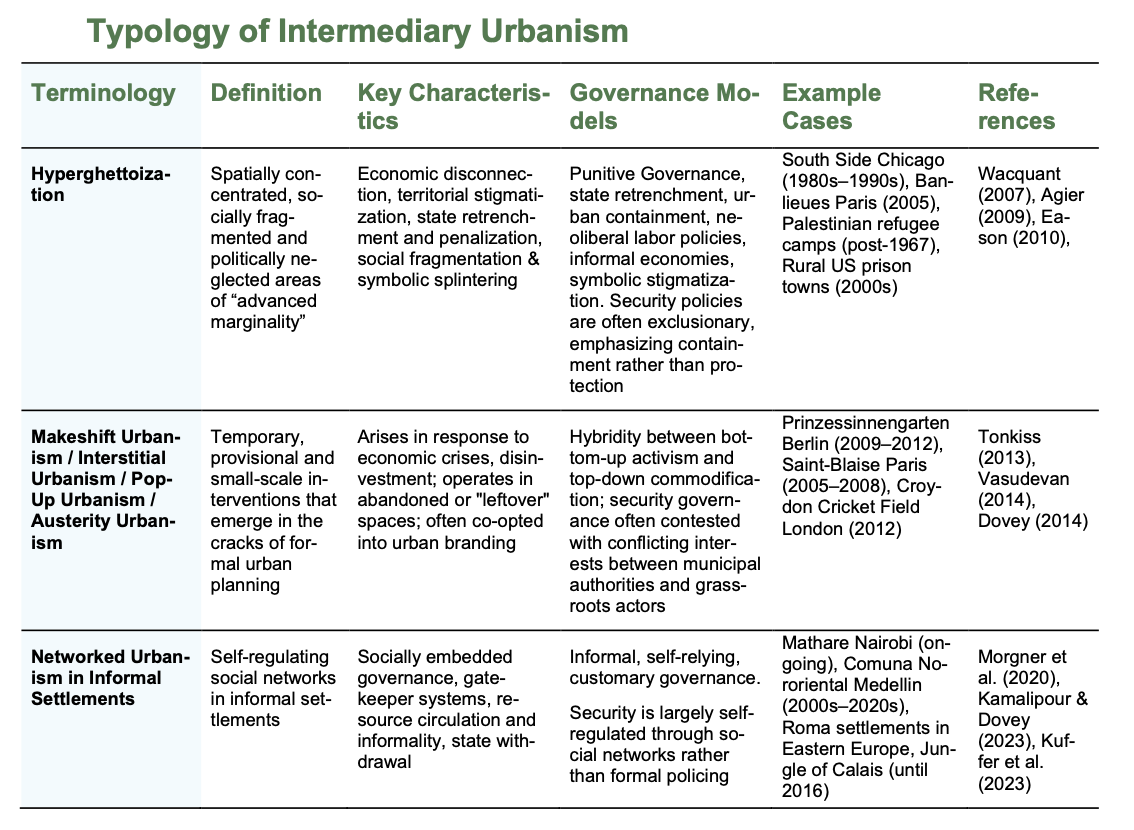
Formally sanctioned interim uses have become increasingly popular in European cities. They have also become linked more closely to debates on (in-)security, however, giving rise to specialized scholarly and practitioner literatures on that linkage. In this journal article, Thomas Betschart and I map out and then critically interrogate the directions of this emergent knowledge base. We situate the literatures and ponder the clarity with which they define their core concepts, i.e., ‘security’ and ‘interim space’. We then reflect on the ways the literatures apprehend the governance of such spaces, and on the impact of temporality and termination on the security politics of such places. In the article, we argue that the emergent knowledge base highlights an increasingly popular phenomenon—but also that its conceptual precision requires further sharpening still, and that it ought to be developed into a considerably more holistic, empirical and critical perspective more generally.
Thomas Betschart; Jonas Hagmann (2026). Interim urban uses and the politics of safety: Interrogating the emergent scholarly and practitioner knowledge base. Urban Studies. OnlineFirst. PDF
 In 1975–1976, Lebanon and the city of Beirut were consumed by devastating armed conflict. But whereas this empirical fact is uncontested, its historical causes and political meanings remain controversial. Sara Fregonese’s book War and the Cityfocuses on the rationalisation of the conflict and asks: Do Western descriptions of the war live up to the realities observed in Beirut? War and the City puts the spotlight on important political practices, which are the ways actors co-construct meaning in and through their own urban environments, and how those interpretations may develop differently from far-away truth claims. This said, the book also includes (exceedingly) structuralist narratives, and it raises important questions about whose perspectives (in Beirut) are listened to and heard. Furthermore, its treatments of works from related disciplines – security studies and International Relations especially – is underdeveloped if not outright crude.
 :: Jonas Hagmann ::