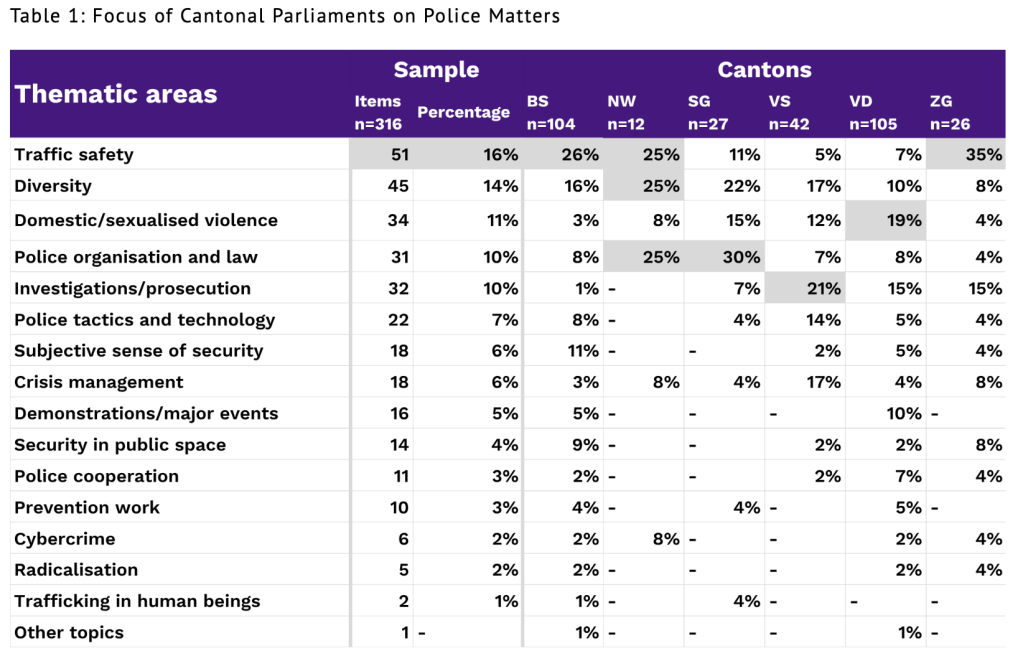
In Switzerland, the police sector is primarily a cantonal policy area – which means it is widely distributed across an uneven field of subnational entities. Also because of this, political debates surrounding policing in Switzerland are largely under-researched today. A systematic inter-cantonal understanding of how the police is a subject of political debate, for example, is still lacking. In a new snapshot analysis focusing on six cantons and one legislative year, Anna Grüninger and I shed light on how members of the cantonal parliaments engage with policing matters. The findings point to varying degrees of parliamentary activity, and a wide thematic range in their dealings with police issues — coupled with a notable reluctance to employ the most powerful parliamentary tools.

Grüninger, Anna; Hagmann, Jonas (2025). Umstrittene Polizei: Wie sich die Kantonsparlamente mit dem Polizeiwesen befassen / Comment les parlements cantonaux traitent-ils la police? / Controversial police: How the cantonal parliaments deal with policing. DeFacto. 24 September/27 October. PDF DE / PDF FR / PDF EN
 ‘Security’ has for the most part been considered a special kind of politics by observers, as one that closes down inclusive policy-making and democratic debate. This Special Issue reviews theoretical and empirical developments at the intersections of ‘security’ and ‘politics’. It argues that research centering on the notion of politicization offers new ideas on how to addresses this complex and evolving conceptual tandem, and importantly, helps elucidate the growing range of actors, arenas and arguments factually visible in contemporary security affairs. The Special Issue develops a framework around the dimensions of controversy, mobilization and arena-shifting, and showcases the potential of such a perspective through empirical illustrations and theoretical examinations, covering issues such as post-Snowden public-policy controversy in Germany, lay participation in European security strategy-making, and the evolving role of the British parliament in UK security politics. The Special Issue’s ambition is to re-engage the relationship between security and politics, to inspire innovative new empirical work on ‘politics around security’, and to empower more differentiated inquiries into the ambivalent consequences of politicization.
 :: Jonas Hagmann ::