 ‘Security’ has for the most part been considered a special kind of politics by observers, as one that closes down inclusive policy-making and democratic debate. This Special Issue reviews theoretical and empirical developments at the intersections of ‘security’ and ‘politics’. It argues that research centering on the notion of politicization offers new ideas on how to addresses this complex and evolving conceptual tandem, and importantly, helps elucidate the growing range of actors, arenas and arguments factually visible in contemporary security affairs. The Special Issue develops a framework around the dimensions of controversy, mobilization and arena-shifting, and showcases the potential of such a perspective through empirical illustrations and theoretical examinations, covering issues such as post-Snowden public-policy controversy in Germany, lay participation in European security strategy-making, and the evolving role of the British parliament in UK security politics. The Special Issue’s ambition is to re-engage the relationship between security and politics, to inspire innovative new empirical work on ‘politics around security’, and to empower more differentiated inquiries into the ambivalent consequences of politicization.
Hagmann, Jonas; Hegemann, Hendrik; Neal, Andrew (2018). The politicization of security: Controversy, mobilization, arena shifting . European Review of International Studies 5(3): 3-29. URL ToC
With contributions by Karin Aggestam, Annika Bergman Rosamond, Myriam Dunn Cavelty, Matthias Leese, Andrew Neal, Pinar Bilgin Fiona de Londras, Eric van Rythoven, Jonas Hagmann and Hendrik Hegemann.
The Special Issue was followed up in 2020 by a Review Forum with contributions by Linda Monsees, Mike Slaven, Akos Kopper, Andras Szalai and Stefan Kroll. See European Review of International Studies 7(1): 105-122. URL
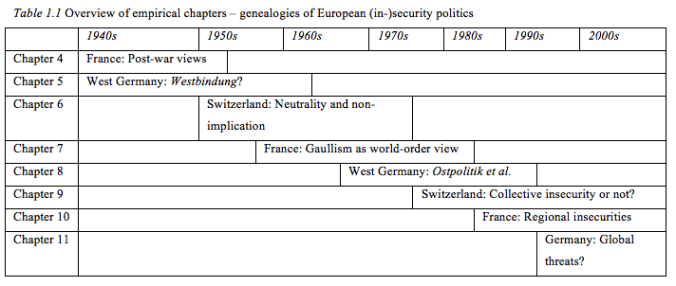
 How do notions of collective international insecurity come about, and what are their effects on foreign policy-making? The Copenhagen School’s securitization theory offers a powerful take on the political construction of threats. In its original variant, however, the theory focuses strongly on the deontic (norm-breaking) powers of ‘security talk’ – and not on the threat sceneries that the latter substantively describes. This article addresses this latter link by reworking securitization into a positional/relational argument. Seen its way, the framing of something as threatening comes with larger – often implicit – claims about threatening and threatened actors in world politics. The empirical cases on post-war France and West Germany show how securitization equals an epistemological systematization of international affairs, for the political construction of collective international danger becomes an ordering process that conditions foreign policy strategizing.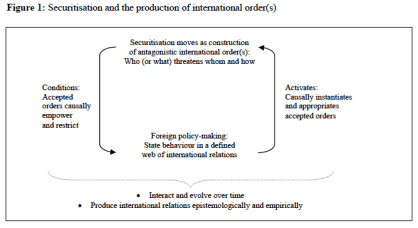

 :: Jonas Hagmann ::