Cities gain importance as actors and objects (inter-)national security politics. This is because cities are the preferred habitats of the majority of the world’s population – but also following expanding and increasingly multidimensional narratives of public (in-)security. How do cities become referent objects of security planning? How do urban security strategies differ globally? How holistic do security policies become when designed at the city-level – and how inclusive and democratic can they be?
The security politics of interim urban spaces
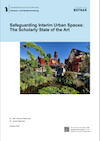
Intermediary urban spaces – temporary uses, occupations of vacant land, and informal appropriations – become increasingly relevant in urban developments across European cities. They act as flexible, adaptive nodes within the urban fabric and carry the potential to foster social innovation. Yet, their activation poses complex questions of public security. On one hand, interim spaces support safety by encouraging informal monitoring and creating social presence. On another, their temporary status, ambiguous governance and informality poses specific challenges for policing, safety and control. A set of studies available both in English and German takes stock of the relevant scholarly and practitioner knowledge. They summarize existing findings, identify lacunas and shortcomings, and chart ways ahead for the creation of a more holistic body of knowledge centering on the security politics of interim urban spaces.
Gallery: Typology of interim urban spaces and overview of urban security networks
Betschart, Thomas; Hagmann, Jonas (2025). Safeguarding interim urban spaces: the scholarly state of the art. Basel: Kantons- und Stadtentwicklung Basel-Stadt, 29p. PDF/ URL
Betschart, Thomas; Hagmann, Jonas (2025). Safeguarding interim urban space: a review of practitioner knowledge. Basel: Kantons- und Stadtentwicklung Basel-Stadt, 24p. PDF / URL
Betschart, Thomas; Hagmann, Jonas (2025). Die Gestaltung von sicheren Zwischennutzungen: Ein Überblick der wissenschaftlichen Literatur. Basel: Kantons- und Stadtentwicklung Basel-Stadt, 32p. PDF / URL
Betschart, Thomas; Hagmann, Jonas (2025). Sichere Zwischennutzungen gestalten. Ein Überblick über das Wissen aus der Praxis. Basel: Kantons- und Stadtentwicklung Basel-Stadt, 24p. PDF / URL
Mapping urban security practices
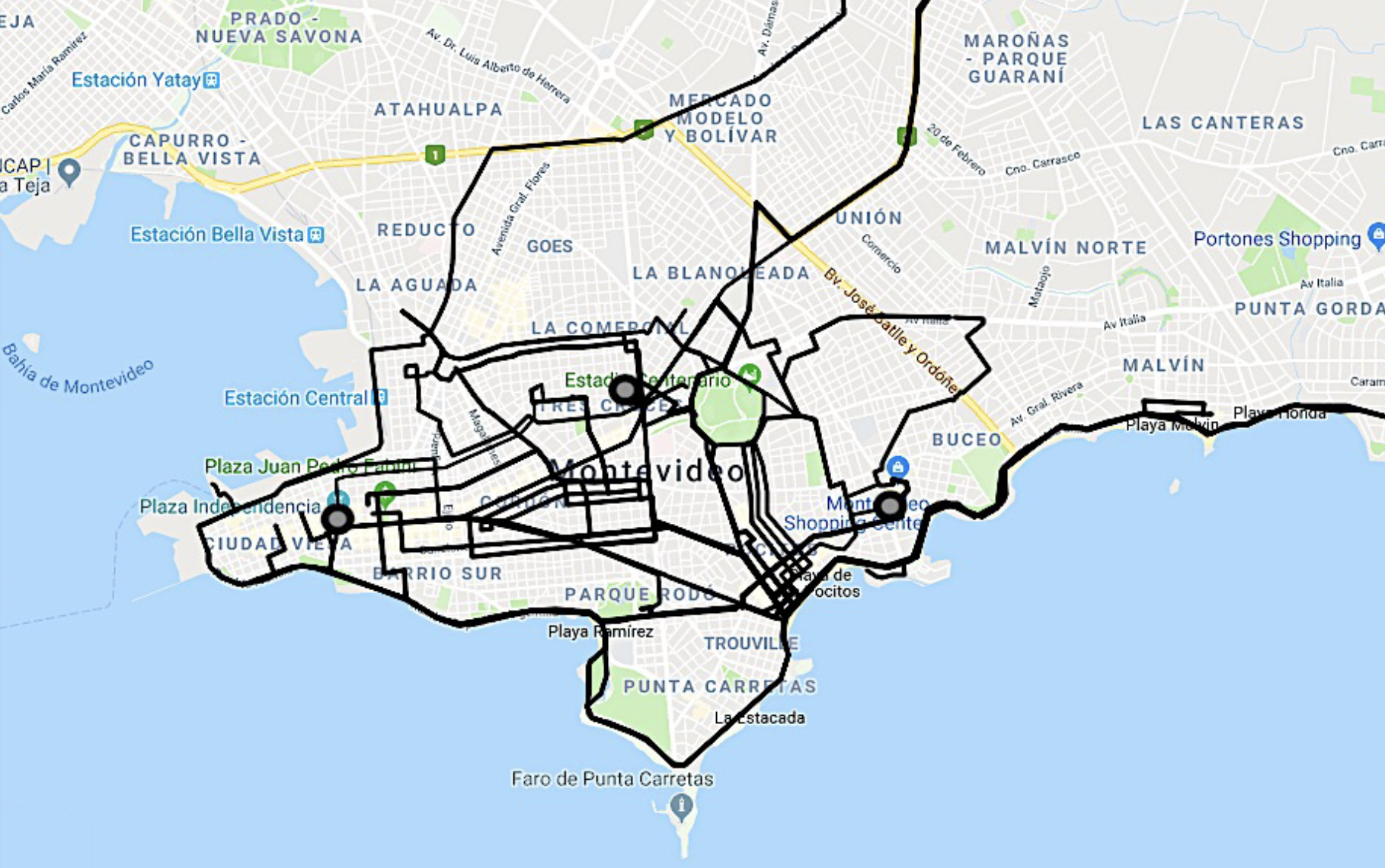
 What is a city and how do we recognize and assess security dispositives in public spaces? This chapter draws on my research program and fieldwork in Switzerland, Morocco, Nepal and Uruguay. It presents ways of systematizing urban space, and discusses how research on human, digital, physical and conceptual urban control elements can be operationalized: How can we create case studies representative of an entire city? What role do interviews play and whom should we talk to to collect data? Can we retrace practices across longer periods of time? And then – how to compare findings across radically different cities/polities? Urban security practices are extraordinarily rich, deterritorialised and interdisciplinary. A critical approach to data collection and analysis allows recognizing this – and it helps to avoid reproducing simplistic and universalizing accounts of security.
Taxi-time in Montevideo: Sub-city labs, simplified research itinerary
Hagmann, Jonas (2023). Mapping urban security practices. In: Salter, Mark; Mutlu, Can; Frowd, Philippe (eds.). Research Methods in Critical Security Studies, pp145-154. London: Routledge. PDF
Globalizing urban security research
 How do urban security assemblages evolve? Scholars inspired by Gilles Deleuze’s influential Control Thesis see profound shifts in the ways urban security operates. Different to Michel Foucault’s disciplinary logics, they argue, urban security assemblages now rely intimately on expanding casts of policing agents, digital surveillance and statistical knowledge(s). They reach beyond enclosures and national borders, and they challenge democratic politics ever more forcefully. Whether this general trajectory of security management holds true across the global cityscape is yet far from evident. Not only do most studies of contemporary control draw conclusions from European and North American cities exclusively. Many also reproduce and project abroad distinctively Eurocentric assumptions about state-society relations, governance and insecurity. This article in Journal of Global Security Studies first foregrounds and problematizes these penchants. It then looks at the Moroccan city of Marrakech to detail how urban security assemblages may evolve in different ways, at other speeds, and following different steering logics than what is generally set out by research on control. The article concludes with a discussion of how insights offered by places such as Marrakech contribute to more robust, analytically refined and globally inclusive research on the contemporary politics of urban security.
Securing Marrakech – Place Jemaa El-Fna
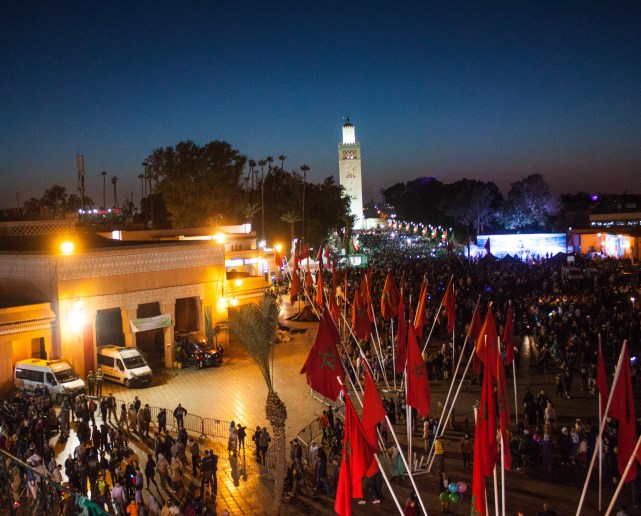
Hagmann, Jonas (2021). Globalizing control research: The politics of urban security in and beyond the Alaouite Kingdom of Morocco. Journal of Global Security Studies 6(4): 1-23. PDF
Unpacking geopolitics: Urban conflict in Beirut 1975-1976
 In 1975–1976, Lebanon and the city of Beirut were consumed by devastating armed conflict. But whereas this empirical fact is uncontested, its historical causes and political meanings remain controversial. Sara Fregonese’s book War and the City focuses on the rationalisation of the conflict and asks: Do Western descriptions of the war live up to the realities observed in Beirut? War and the City puts the spotlight on important political practices, which are the ways actors co-construct meaning in and through their own urban environments, and how those interpretations may develop differently from far-away truth claims. This said, the book also includes (exceedingly) structuralist narratives, and it raises important questions about whose perspectives (in Beirut) are listened to and heard. Furthermore, its treatments of works from related disciplines – security studies and International Relations especially – is underdeveloped if not outright crude.
Hagmann, Jonas (2022). War and the city: Urban geopolitics in Lebanon (Sara Fregonese), London, Tauris, 2020. Urban Studies 59(12): 2604-2607. PDF
Urban design as technology of (counter-) democratic security politics
 Urban design is increasingly widely used for city-oriented security production, and thus becomes included into the latter’s complex politics of in- and exclusion. This contribution showcases how urban design becomes deployed as a technology of security both internationally and in Switzerland, and how a reflexive security studies perspective on this use offers productive new research avenues. This is because the focus on urban design allows asking in new ways whether ‘more security is better’, how technological interventions are used and appropriated, and how they reconfigure democratic processes. Security research drawing on reflexive IR and security studies is well placed to this endeavour, as it proposes integrative and dialectical analyses of how built environments may be empowering/disempowering and inclusive/exclusive. The contribution sets out the specificities of this research ontology, presents urban design’s operation as technology of security politics, and illustrates said link in two mini-case studies centring in Bogotá and Zürich. In line with the special section to which it contributes, the article seeks to familiarize readers with architecture-oriented political analysis, and to draw out main lines of further investigation.
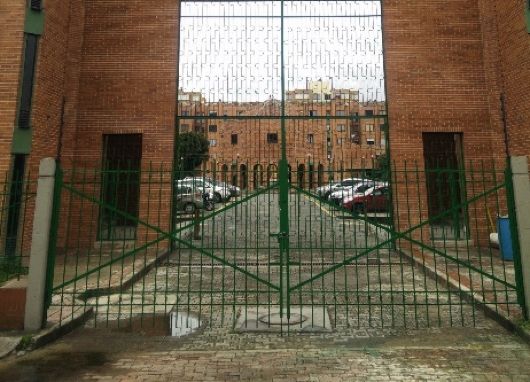
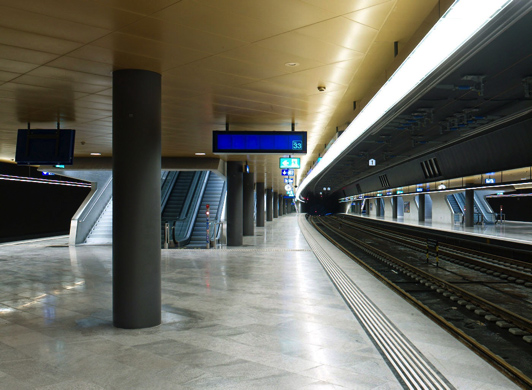
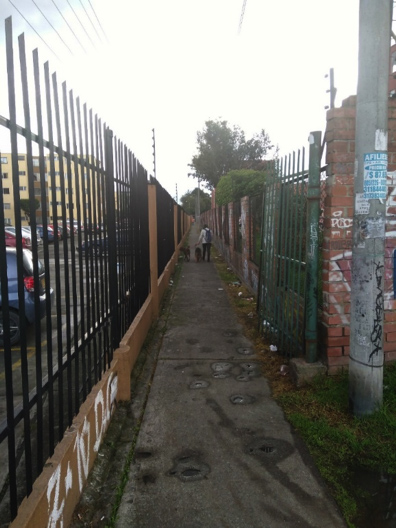
Hagmann, Jonas; Kostenwein, David (2021). Urban design as technology of (counter-) democratic security politics. Swiss Political Science Review 27(1): 193-204. PDF
The politics and practices of securing urban spaces
According to some, societal steering evolved from an analogue disciplining of enclosures into a network-centric, privatised, digital and global form of control. This article engages this claim from an empirical security studies perspective. In the age of globalisation and urbanisation, technological innovation and liberal policy ideals, how are security apparatuses reorganised, and in what relations do they stand to local societal and political orders? The article argues that while there is an impressively rich, integrative and topical research agenda on urban security management, its empirical applications may still benefit from further development. To this aim, the article first systematises the various substantive points made by the literature. It then employs a spatial heuristic to enquire into the securing of three urban spaces – a site of mobility (HB Zürich), a public square (Bundesplatz Bern) and a place of mass commerce (St. Jakob Park Basel) – in Switzerland. Forgoing universalisms about societal steering, the article makes the case for more nuanced engagements with urban security ensembles, their technological evolution, relations with democratic ideals, globalisation and de-territorialisation both in and beyond Western polities.
Securing public space in Switzerland – Bundesplatz Bern 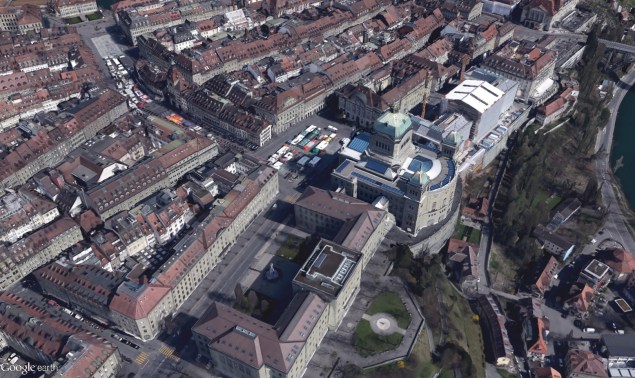
Hagmann, Jonas (2017). Security in the society of control: The politics and practices of securing urban spaces. International Political Sociology 11(4): 418-448. PDF
Reclaim the fences: Rethinking Barranquilla’s security architecture
 In many European and North American cities, reclaiming the street has become an important agenda. By re-appropriating sealed terrain from motorised mobility, so the idea, public space is reinvigorated and widened – even if only temporarily. When visiting Barranquilla this spring for the inauguration of Universidad del Norte’s Institute of Urban Studies, it struck me that an even more important architectural element to re-conquer is found in the vertical dimension. Certainly, roads are also to be re-appropriated in Barranquilla – and they most effectively are during Carnival season. Another prominent form of separation I observed throughout the centre, however, is posed by the innumerable gates and fences that shoot skywards in front of seemingly each and every building, and which impose physical barriers to shops and homes, even to gardens.
Hagmann, Jonas (2015). Reclaim the fences: Rethinking Barranquilla’s security architecture. Markets in the Tropics (ETH Zürich: Urban Think Tank) 2: 27. PDF
Sicherheit im öffentlichen Raum: Begegnungsorte im Spannungsfeld zwischen Kontrolle, Freiheit und Demokratie
 In öffentlichen Räumen treffen immer zahlreichere und unterschiedlichere Personen, Aktivitäten und Interessen aufeinander, und spiegeln sich dank neuer Kommunikations- und Transportmittel gesellschaftliche und internationale Entwicklungen zunehmend unvermittelt. Damit wird die sicherheitspolitische Handhabung öffentlicher Räume anspruchsvoller. Mit Verweisen auf Fallstudien in Bern, Basel und Zürich beschreibt der vorliegende Beitrag die Entwicklung der sicherheitspolitischen Handhabung öffentlicher Räume in der Schweiz. Er verortet praktische Herausforderungen der geschaffenen Sicherheitsinstrumentarien und diskutiert, wie sie im Spannungsfeld mit höheren gesellschaftspolitischen Idealen bestehen.
Hagmann, Jonas; Saliba, Ilyas (2013). Sicherheit im öffentlichen Raum: Begegnungsorte im Spannungsfeld zwischen Kontrolle, Freiheit und Demokratie. In Nünlist, Christian; Thränert, Oliver (eds.). Bulletin zur Schweizer Sicherheitspolitik, pp91-109. Zürich: Center for Security Studies, ETH Zürich. PDF
 :: Jonas Hagmann ::