This is an overview of major ongoing and completed research projects, both scholarly and applied.
The politics of security of interim urban spaces
Research project – Fondation Botnar and Canton of Basel-Stadt Kantons- und Stadtentwicklung, 2025-2027
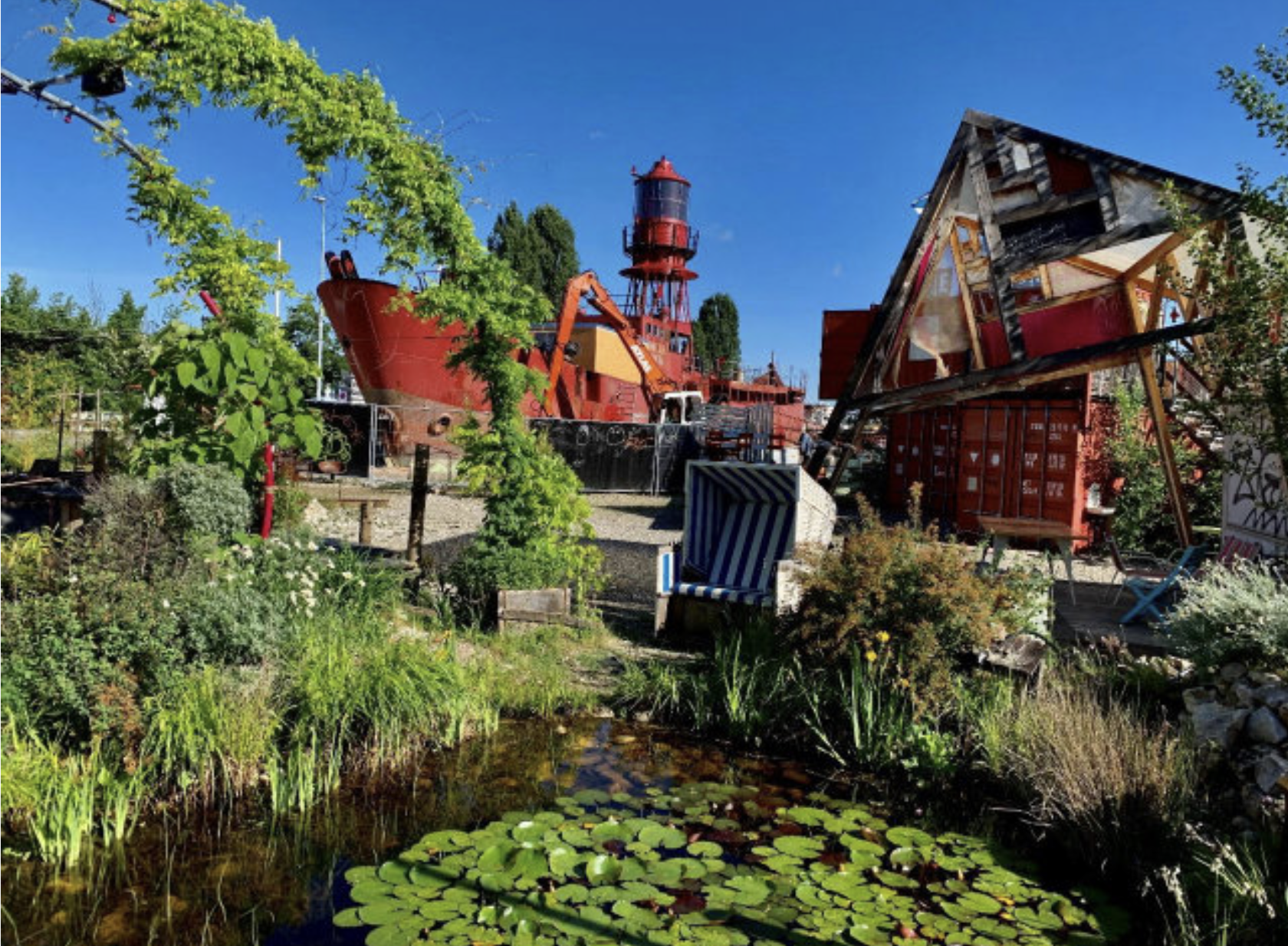 City halls in Europe engage intermediary urban spaces in increasingly strategic ways. The activation of such spaces yet gets entangled in complex questions of public security: Interim spaces enhance safety by encouraging informal monitoring and creating social presence. At the same time, their temporary status, ambiguous governance and informality themselves also poses challenges for policing, safety and control. Funded by Fondation Botnar and embedded in the Canton of Basel-Stadt Kantons- und Stadtentwicklung, this project investigates the politics of security surrounding interim spaces. It systematizes the scholarly state-of-the-art and the practitioner communities’ best practices. Looking at Basel and three other cities, it takes an empirical deep-dive and charts the negotiation of these spaces’ security dimensions in operational practice, political debate and media discourse. The project engages everyday site users and creates a kaleidoscopic mapping of their security demands and aspirations when so doing.
Betschart, Thomas; Hagmann, Jonas (2025). Safeguarding interim urban spaces: the scholarly state of the art / Die Gestaltung von sicheren Zwischennutzungen: Ein Überblick der wissenschaftlichen Literatur. Basel: Kantons- und Stadtentwicklung Basel-Stadt, 29p/32p. PDF EN/ PDF DE / URL
Betschart, Thomas; Hagmann, Jonas (2025). Safeguarding interim urban space: a review of practitioner knowledge / Sichere Zwischennutzungen gestalten. Ein Überblick über das Wissen aus der Praxis. Basel: Kantons- und Stadtentwicklung Basel-Stadt, 24p. PDF EN / PDF DE /URL
Radicalization of Swiss and European police forces
Research project – Abteilung Polizeiwissenschaften, Nationaler Aktionsplan Radikalisierung und Extremismus / Schweizerisches Polizei-Institut, Zürcher Hochschule für Angewandte Wissenschaften, 2024-2026
 The radicalization of security agents can create extensive harm to an agency’s public standing and inner workings. In recent years, the detection, handling and prevention of such dynamics within European security agencies thus emerged as an important international research agenda. How police forces classify and handle the issue in practice is still poorly understood, however. This research project first probes the Swiss police forces’ handling of such cases, based on a survey of media reporting and leadership experiences. It then collects prevention and management (best) practices from European police forces. With its practice-oriented focus, the project supplements the state-of-the-art with institutional accounts of radicalization management inside the police sector.
Hagmann, Jonas; Staubli, Silvia; Gaia, Elisa (2025). Radikalisierung im Schweizer Polizeiwesen: Einordnung von Leitungspersonen aus der Polizeipraxis. Neue Zeitschrift für Kriminologie und Kriminalpolitik – NKrim/NCrim. 2/2025: 48-60. PDF
Staubli, Silvia; Tamm, Nina; Gaia, Elisa; Hagmann, Jonas (2025). Radikalisierung im Schweizer Polizeiwesen: Medienanalyse liefert erste Erkenntnisse. Kriminalistik 10/2025: 565-570. PDF
Abteilung Polizeiwissenschaften / Division for Police Sciences
Hybrid research and support unit – Cantonal Police of Basel-Stadt, 2021-2025
 The Division for Police Sciences was a hybrid and translational research and management support entity of the Cantonal Police of Basel-Stadt, Switzerland’s most urbanized cantonal police force. It intertwined in-house practitioner knowledge with the scholarly state-of-the-art in order to fulfill a four-part mandate: (1) To provide management support (e.g., triage of external requests; create of in-house knowledge management system; granting police agents access to scientific journals; supervision of police agent qualification works), (2) to offer conceptual and strategic support (e.g., writing projects and conceptual work for other units; preparation of the police force’s ‘political dossiers’; representation of the Cantonal Police in working groups), (3) to facilitate police leadership decision making through applied research (e.g., regarding the future reporting of hate crimes; procurement of new technologies; strategic orientation of police-based prevention work; protection of police agents’ privacy), and (4) to conduct applied and scholarly public research based on acquired third party funds (e.g., on police-based data systems; prevention of radicalisation; hot-spot policing). The Division delivered its products directly to the police leadership and the cantonal political leadership, as well as to police officers and police-interns working groups at all levels. It shared its public studies via its website and its widely-circulated national police research newsletter.
Hagmann, Jonas (2024). Wissenschaft mit, für und über Polizei: Hybride Polizeiforschung bei der Kantonspolizei Basel-Stadt. SKP Info Sonderheft Wissenschaft und Kriminalität 2/2024: 9-11. PDF DE / PDF FR / PDF IT
Hagmann, Jonas (2024). Hybride Forschung mit, für und über Polizei: Ein Blick in die Arbeit der Abteilung Polizeiwissenschaften. BasileaInfo 1/2024: 8-9. PDF
Hagmann, Jonas; Wolf, Anna (2023/2024). Wie sich Polizei und Wissenschaft nun auch in der Schweiz besser entdecken / La police prend enfin sa place dans la recherche scientifique en Suisse / How the police and academia are discovering each other in Switzerland. DeFacto. 29 November 2023/10 January 2024. PDF DE / PDF FR / PDF EN
Hagmann, Jonas; Roth, Martin (2023). Die Basler Polizeiwissenschaften: Wissenschaft für, mit und über die urbane Polizeiarbeit. Basel: Kantonspolizei Basel-Stadt, 2p. PDF
UNSCdeb8
Research project – Swiss National Science Foundation, University of Geneva and ETH Zurich, 2019-2021
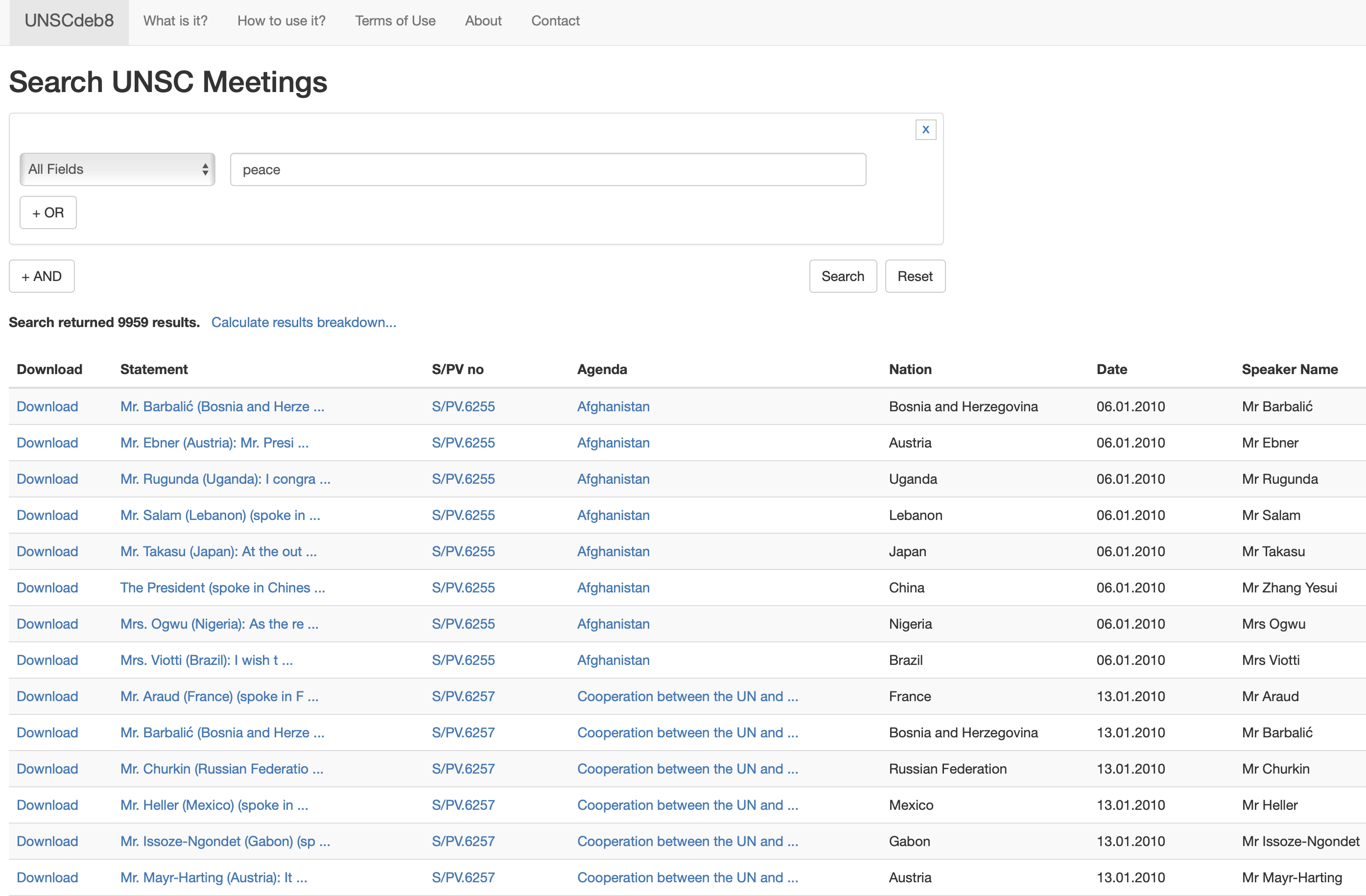 UNSCdeb8 is a queryable database containing all verbatim statements given at the United Nations Security Council between 2010-2018. As a public resource, it allows users to identify, trace and map specific terms and word combinations within the comprehensive corpus of articulations made at the Council. Different to the single-session PDFs and annual reports provided by the United Nations, UNSCdeb8 empowers crosscutting and customizable analyses of statements across all Council meetings, reporting years and UNSC seats. It thus represents a flexible and easy way to support existing methods of unpacking and studying UNSC dynamics. UNSCdeb8 is primarily designed to facilitate corpus-driven social science research focussing on the UN Security Council. It also makes UN Security Council discussions more transparent and accessible to a wider interested public, however, and operates as a resource for diplomats, analysts, activists and other international affairs practitioners. UNSCdeb8 (https://unscdeb8.ethz.ch) resulted from a research project originally led by Stephen Aris and Aglaya Snetkov.
The politics of security and technology in Switzerland
Special section – Swiss Political Science Review, 2021
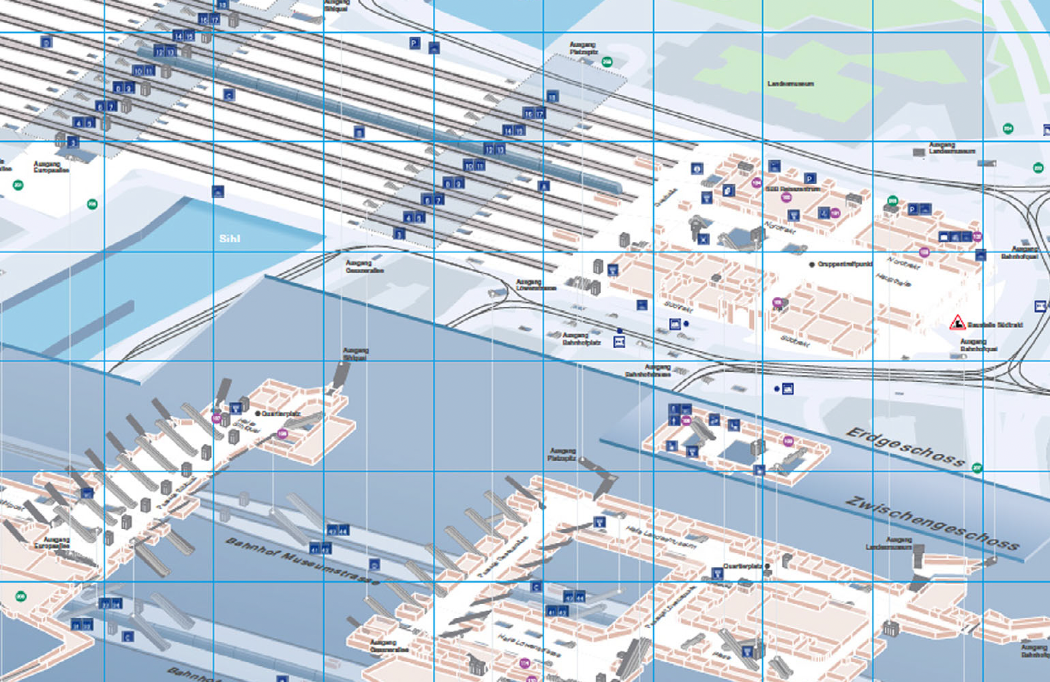 Scholars increasingly draw on reflexive research traditions to understand how social and political practices influence the shape, design and use of security technologies. In doing so, they abandon more traditional viewpoints that suggest new technologies to imprint themselves unilaterally on professional practices. The special section applies this new perspective to the field of Swiss security politics. Its contributions analyze how cybersecurity, predictive policing, drones, artificial intelligence, targeted sanctions, urban design and spyware are deliberated, negotiated, programmed and critiqued by Swiss security professions/stakeholders. They chart analytical avenues with which to address the non-linear relationship between security politics and technologies, and, by familiarizing readers with the tenets and diversity of reflexive political science research, give that longstanding scholarly research tradition better visibility in Swiss political science.
Dunn-Cavelty, Myriam; Hagmann, Jonas (2021). The politics of security and technology in Switzerland. Swiss Political Science Review 27(1): 128-138. PDF
Hagmann, Jonas; Kostenwein, David (2021). Urban design as technology of (counter-) democratic security politics. Swiss Political Science Review 27(1): 193-204. PDF
The global variation of urban security dispositives
Ambizione grant – Swiss National Science Foundation and ETH Zürich, 2016-2019
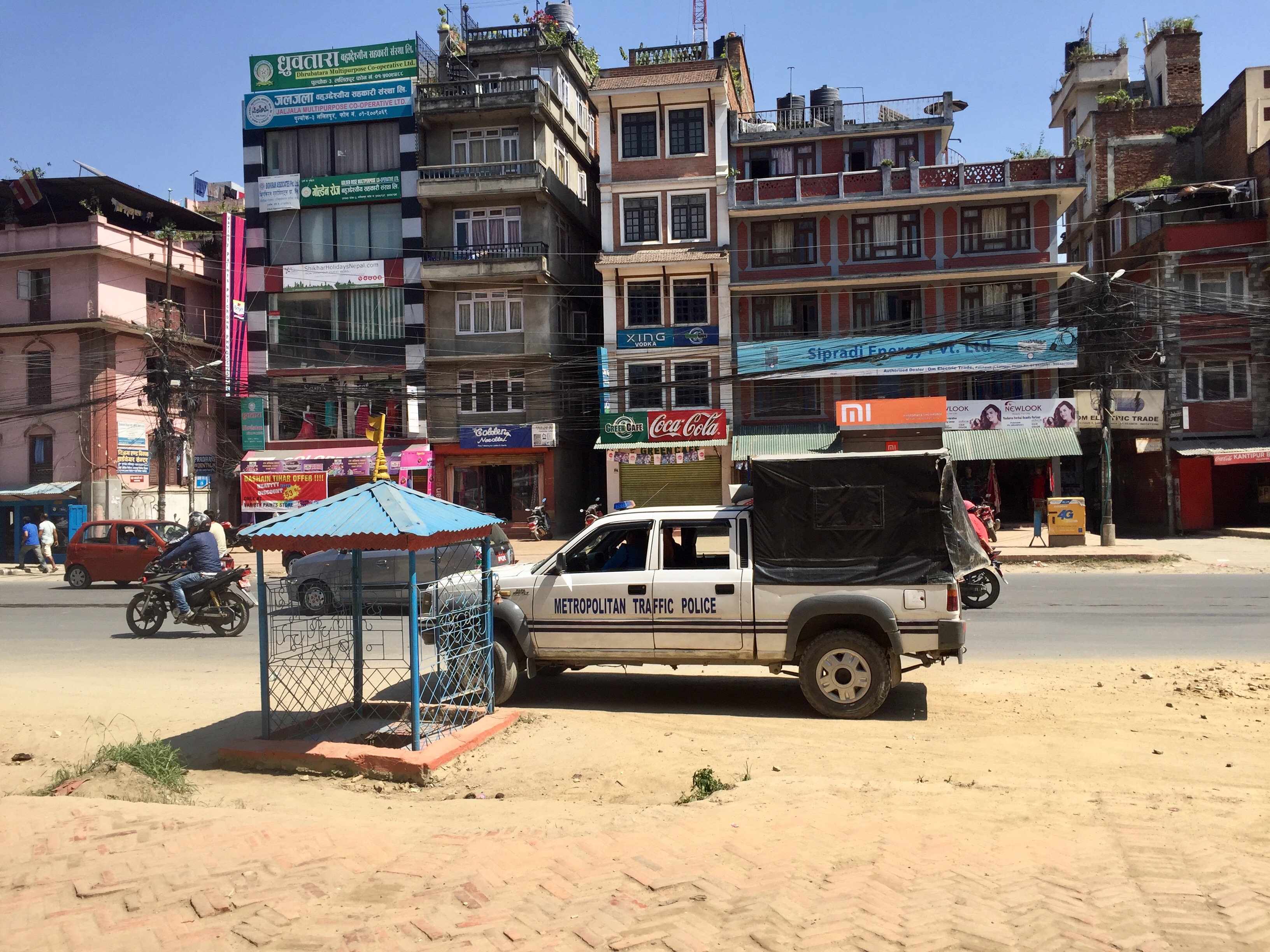 How do security dispositives evolve in cities across the globe? According to security specialists, we witness profound shifts in the ways urban security operates: Security assemblages rely on more extensive casts of policing agents, digital surveillance, and statistical knowledges today. They also reach beyond city perimeters and national borders, and they curtail democratic politics ever more forcefully. Based on in-depth empirical research in Switzerland, Morocco, Nepal and Uruguay, this research project questions this purported general trajectory of urban security management. It first examines how the existing urban security literature projects onto the globe distinctively Eurocentric assumptions about state–society relations, governance, and insecurity, and with little engagement of empirical urban security practices beyond Western cities. Second, it offers detailed case studies of how urban security assemblages evolve in different ways, at other speeds, and following different steering logics in different political and social contexts. The project’s overarching contribution is to show how a serious empirical engagement with the global diversity of urban security dispositives empowers a considerably more robust, analytically refined, and globally inclusive research agenda on the contemporary politics of urban security.
Hagmann, Jonas (2023). Mapping urban security practices. In: Salter, Mark; Mutlu, Can; Frowd, Philippe (eds.). Research Methods in Critical Security Studies, pp145-154. London: Routledge. PDF
Hagmann, Jonas (2022). War and the city: Urban geopolitics in Lebanon (Sara Fregonese), London, Tauris, 2020. Urban Studies 59(12): 2604-2607. PDF
Hagmann, Jonas (2021). Globalizing control research: The politics of urban security in and beyond the Alaouite Kingdom of Morocco. Journal of Global Security Studies 6(4): 1-23. PDF
Hagmann, Jonas (2017). Security in the society of control: The politics and practices of securing urban spaces. International Political Sociology 11(4): 418-448. PDF
Hagmann, Jonas; Saliba, Ilyas (2013). Sicherheit im öffentlichen Raum: Begegnungsorte im Spannungsfeld zwischen Kontrolle, Freiheit und Demokratie. In: Nünlist, Christian; Thränert, Oliver (eds.). Bulletin zur Schweizer Sicherheitspolitik, pp91-109. Zürich: Center for Security Studies, ETH Zürich. PDF
Governing and living with urban insecurity in Cape Town townships
Doctoral school – ETH Zürich and University of Cape Town, 2018

The Cape Flats are a legacy of the apartheid era, and a vast urban space where social, material and corporeal everyday insecurities abound. This intensive two-week ETH Zurich/University of Cape Town doctoral school is held on-site in South Africa. It consists of a series of specialized scholarly lectures at the University of Cape Town and its African Centre for Cities. It includes multiple days of in-depth doctoral school fieldwork on the everyday politics of insecurity in the Khayelitsha township. It furthermore comprises comprehensive first-hand engagement with all central public security providers and local community stakeholders.
Democratic experimentalism in European and North American security politics
Special issue – European Review of International Studies, 2018
 Security affairs is often qualified a special kind of politics that is closing down inclusive democratic debate. This special issues questions this traditional framing, and focuses on the growing range of actors, arenas and arguments that participate in contemporary security governance. Based on recent literatures from Political Science and European Studies thus far ignored in Security Studies, it proposes to focus on controversy, mobilisation and arena-shifting as contemporary means for ‘politicizing’ security questions. The special issue illustrates these process in a set of empirical cases ranging from the Snowden affair to parliamentary control, lay participation and the cybersecurity domain. The special issue’s aim is to reopen conceptual questions about the relationship between security and politics, and to allow more differentiated normative inquiries into the ambivalent effects of politicization.
Hagmann, Jonas; Hegemann, Hendrik; Neal, Andrew (2018). The politicization of security: Controversy, mobilization, arena shifting. European Review of International Studies 5(3): 1-162. URL
Empirical cartography of Swiss national security practice
Research project – Swiss National Science Foundation, ETH Zürich and University of Geneva, 2014-2016
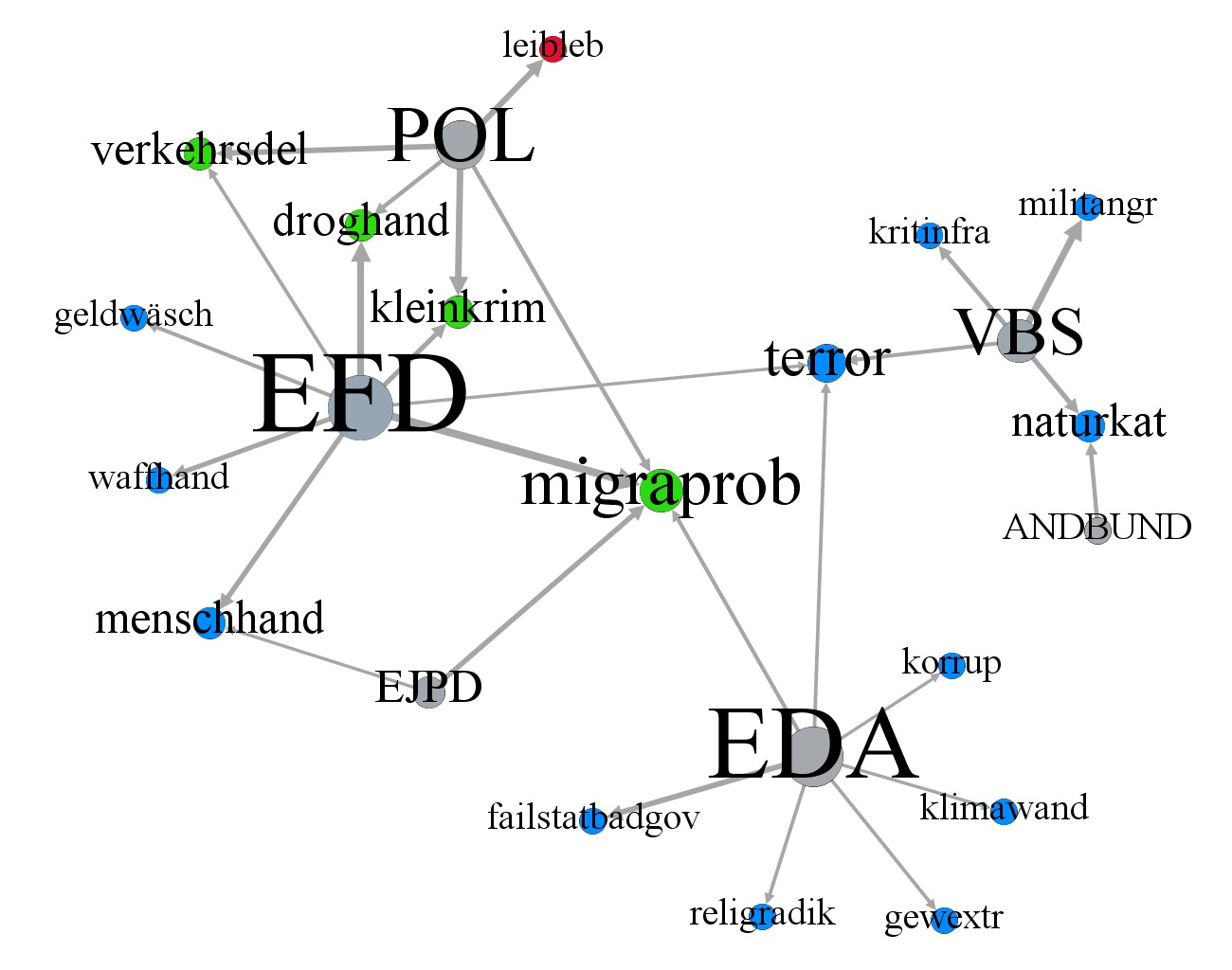 On what dangers does the Swiss national security field focus – and by means of what interagency cooperation? Government strategies sketch out broad panoramas of inter-professional security work, and they set out holistic agendas that suggest all kinds of dangers to be addressed in similar ways. This research project questions such presentation. It adopts a practice-theoretical lens to study empirically on what problems security professionals focus, how much time they spend on such work, and with whom they collaborate when so doing. Based on over 600 profiles, the project reveals how security practices are concentrated and often unevenly distributed in reality, thus standing in contrast to what doctrines and strategies make believe. It also shows how Swiss security work operates is impressively transnational ways at lower scales of government.
Davidshofer, Stephan; Tawfik, Amal; Hagmann, Jonas (2024). Security as a field of force: the case of Switzerland in the mid-2010s. In: Dubois, Vincent (ed.). Bringing Bourdieu’s Theory of Fields to Critical Policy Analysis, pp. 74-89. Cheltenham: Edward Elgar. PDF
Davidshofer, Stephan; Tawfik, Amal; Hagmann, Jonas (2023). La politique de sécurité comme produit du rapport de forces au sein du champ. Le cas de la Suisse au milieu des années 2010. In: Dubois, Vincent (ed.). Les structures sociales de l’action publique : Analyser les politiques publiques avec la sociologie des champs, pp127-163. Paris: Editions du Croquant. PDF
Hagmann, Jonas; Davidshofer, Stephan; Tawfik, Amal; Wenger, Andreas; Wildi, Lisa (2018). The programmatic and institutional (re-)configuration of the Swiss national security field. Swiss Political Science Review 24(3): 215-245. PDF / Score tables / OpenAccess URL
Davidshofer, Stephan; Tawfik, Amal; Hagmann, Jonas (2017). La sécurité suisse: entre neutralité et impératif de coopération. Questions internationales 87 (2017/5): 25-29.
Davidshofer, Stephan; Tawfik, Amal; Hagmann, Jonas (2017). Les « Schengen Boys » et le nouvel ordre sécuritaire. DeFacto. 25 April. PDF / URL
Hagmann, Jonas; Wenger, Andreas; Wildi, Lisa; Davidshofer, Stephan; Tawfik, Amal (2016). Schweizer Sicherheitspolitik in der Praxis: Eine empirische Momentaufnahme. In: Nünlist, Christian; Thränert, Oliver (eds.). Bulletin zur Schweizer Sicherheitspolitik, pp99-134. Zürich: Center for Security Studies, ETH Zürich. PDF
Hagmann, Jonas; Davidshofer, Stephan (2016). Der Bevölkerungsschutz im Sicherheitssystem Schweiz: Trotz zentralem Leistungsmandat begrenzt vernetzt? AlertSwiss. Bundesamt für Bevölkerungsschutz. 1 December. PDF DE / URL FR
Davidshofer, Stephan; Tawfik, Amal; Hagmann, Jonas (2016). Analyse du champ de la sécurité en Suisse : vers une hypertrophie de la sécurité intérieure et autres réflexions méthodologiques. Cultures & Conflits 102 (2016/2): 59-93. PDF
The influence of schools and academies on the study of international politics
Special section – International Studies Review, 2016
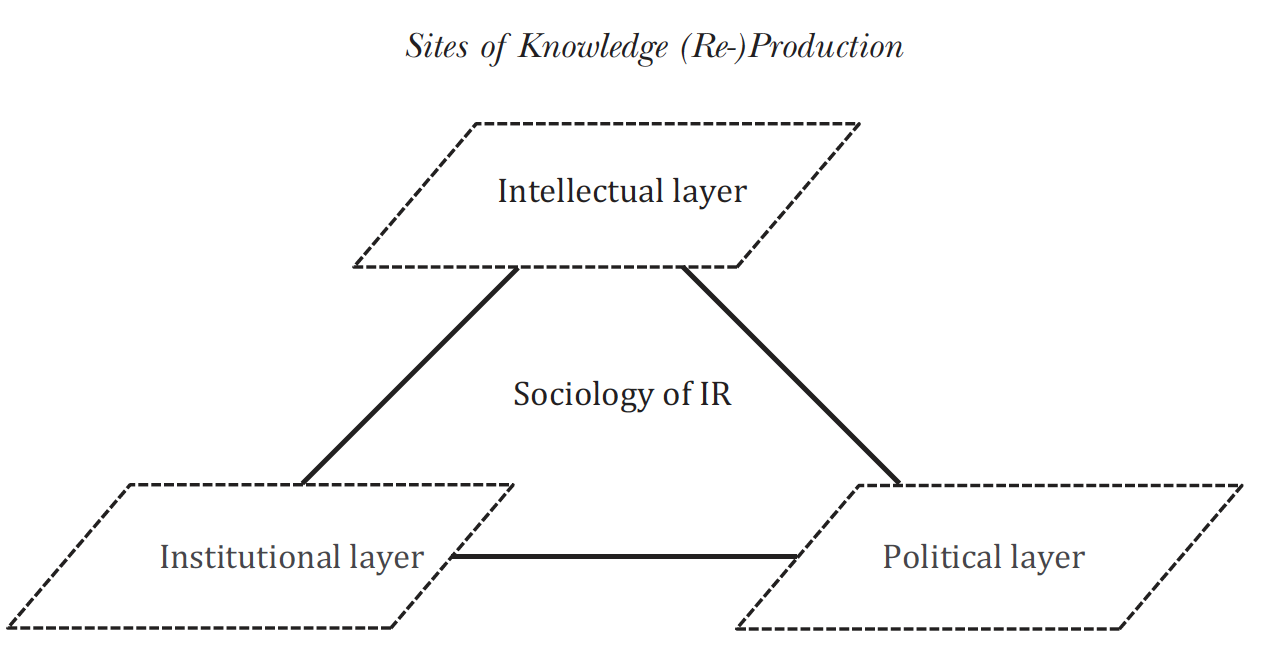 In 1998, IR scholar Ole Wæver proposed to analyse the International Relations discipline as the combined result of intellectual, institutional and political forces. His argument gave way to an extensive reflexive body of work studying IR scholarship. This literature mainly focuses on intellectual and political drivers of disciplinary knowledge, however, and thus leaves the institutional determinants unexplored. This special section addresses this gap: How is the production of ‘international knowledge’ institutionalized in different places, and how is it governed by material and immaterial constraints there? The section’s six contributions focus on university departments, diplomatic schools and military academies as places where IR is taught and developed. The section highlights the empirical diversity of settings where specialized knowledge about international politics is produced and instantiated, and it illustrate how the focus on the discipline’s institutional embedding helps develop the corresponding reflexive literature.
Hagmann, Jonas; Lebedeva, Marina (2016). Teaching (as) statist practice: Diplomatic schools as sites of international education. International Studies Review 18(2): 349-353. PDF
Grenier, Félix; Hagmann, Jonas (2016). Sites of knowledge (re-)production: Towards an institutional sociology of International Relations scholarship. International Studies Review 18(2): 333-336. PDF
 :: Jonas Hagmann ::